Design details: Lattice Topology Metal Bracket
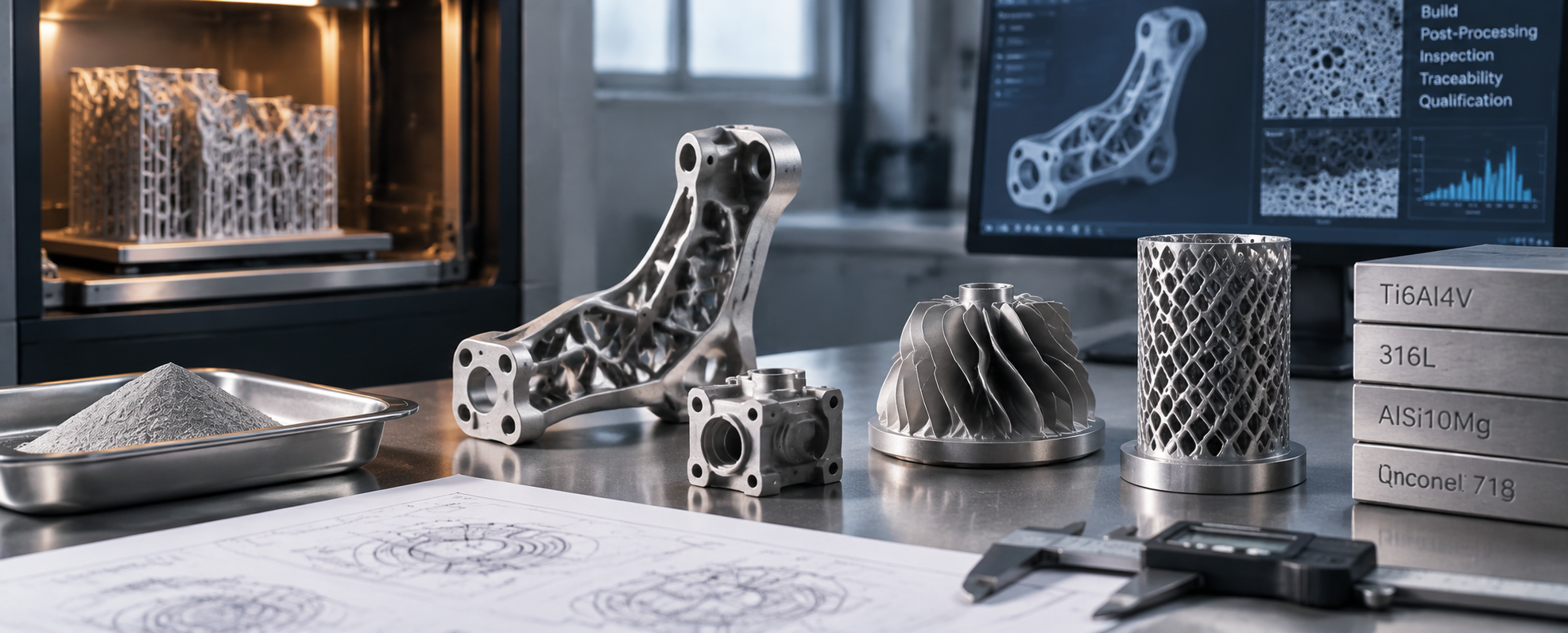
An arched open-cell body connects end mounting features to a central clevis. The lattice occupies the larger span while the mounting features provide more concentrated interfaces for assembly.
An open topology should be reviewed against actual load cases and fatigue requirements. Define which bores and faces need machining, and ensure that powder and inspection tools can reach the lattice interior.
Features to review on a similar design
- Review transitions from lattice to solid mounting features
- Specify bore fits and datum surfaces
- Validate the design against the intended load cases
Metal additive manufacturing review
Metal laser powder-bed fusion can produce curved passages and open structures that are difficult to machine from a solid block. A production plan must also address support removal, powder evacuation, stress relief or other required heat treatment and secondary machining. Choose the alloy from the operating environment and specify critical datums and inspection methods. Surface appearance alone cannot confirm alloy, density, leak tightness or qualification for an aerospace or pressure application.
Explore process capabilities and material optionsBead Blasting considerations
Bead blasting can even out accessible surfaces, but the media and process must match the substrate. Protect precision interfaces and inspect narrow recesses for retained material. Define the intended texture with a sample where the visible appearance is important.
Explore surface finishing optionsPlan a similar custom part
Upload a STEP file for solid geometry or a high-resolution STL/3MF mesh for sculptural forms. Include overall dimensions, quantity, intended use and the faces or details that matter most. Add a drawing for mating interfaces and a color or finish reference for visual models. AIHFabs can review the geometry and manufacturing options before production.
Upload your CAD file Discuss geometry and finish requirements