AIHFABS Announces Major Updates to Solutions and Materials Pages and Introduces B2B Project See More +

3D列印

SLS 3D Printing Services

Professional nylon 3D printing for functional prototypes, jigs, and production-like SLS parts — no support trees on most geometry.

AIHFABS SLS 3D printing services fuse engineering-grade SLS plastics into durable, self-supporting parts. A laser sinters nylon powder layer by layer; unsintered powder holds the geometry, so ducts, hinges, and nested batches print without support scars. Choose sintered nylon when you need tough SLS parts for fit, function, and short-run production — not a show-resin cosmetic.

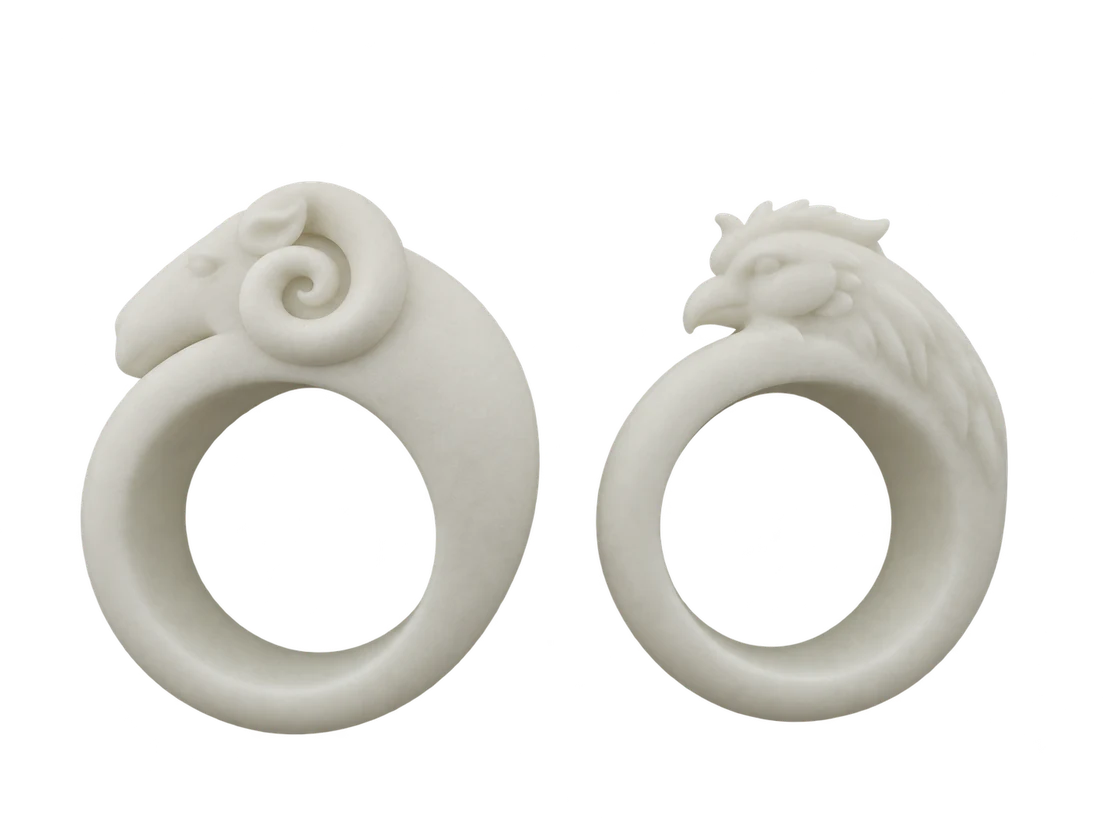
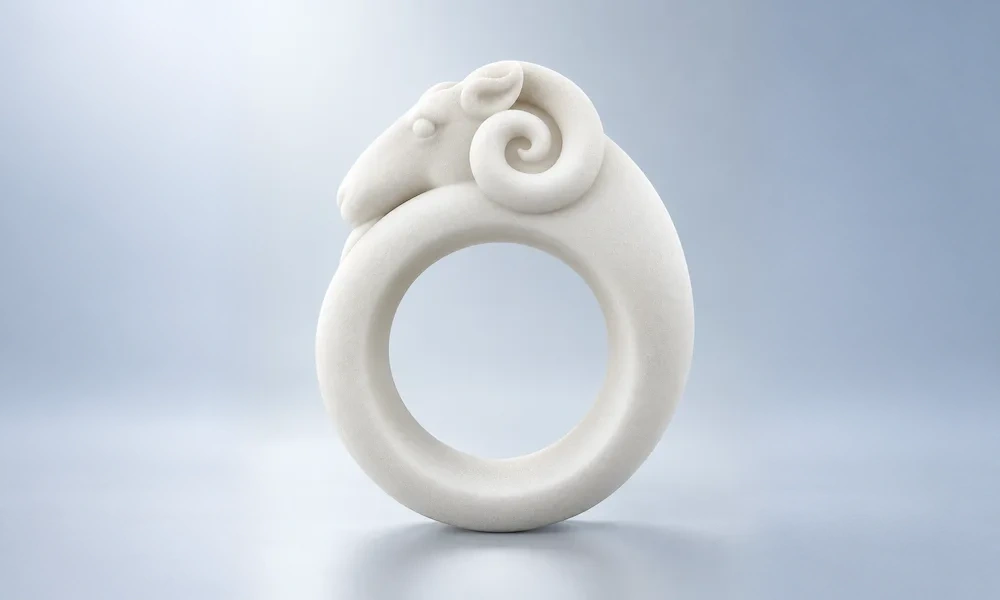
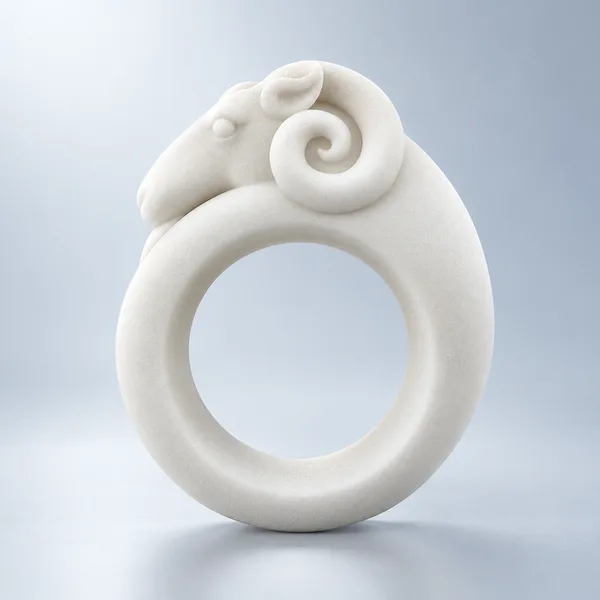
White SLS-printed ring with a sculpted ram head

How Selective Laser Sintering (SLS) Works

See how nylon powder becomes a finished part, from build preparation to laser sintering, cooling and depowdering.

SLS 3D Printing Workflow

  1. CAD Review & Powder Selection

    Review wall thickness, mating features and critical dimensions against the intended use. Select the nylon grade for the required stiffness or toughness. For hollow parts and internal channels, confirm that loose powder can be reached and removed.

  2. Build Orientation, Nesting & Slicing

    Orient parts for dimensional stability, surface quality and powder removal. Nest parts throughout the build volume with clearance between them, then slice the build into layers. The surrounding powder supports the geometry, so separate support structures are generally unnecessary.

  3. Powder Preparation & Bed Preheating

    Prepare the specified powder grade. Where reuse is approved, sieve recovered powder and blend it with fresh powder at the specified refresh ratio. Bring the powder bed to the material-specific preheat setpoint before printing.

  4. Recoating & Selective Laser Sintering

    A recoater spreads a thin, even layer of powder. A laser scans each cross-section and fuses the selected powder to the layer below. The build platform lowers by one layer thickness, and recoating and scanning repeat until the build is complete.

  5. Controlled Cooling & Depowdering

    Let the build cool to the prescribed unpacking temperature to limit distortion. Extract the parts from the powder cake, then remove loose powder from accessible cavities and channels. Sieve suitable recovered powder for reuse.

  6. Surface Finishing & Final Inspection

    Blast away residual surface powder. Apply dyeing or vapor smoothing where specified. Check finished parts against the agreed drawing and acceptance criteria, focusing on critical dimensions, fit and surface condition.

Aihfabs’ Selective Laser Sintering (SLS) 3D Printing Capability

Typical planning values for SLS nylon, with material-specific exceptions below. See the material catalog for PA12, PA11, filled nylon, TPU and glass-filled PP. Final limits are confirmed during drawing review.

SLS manufacturing capability parameters
ParameterCapability
Max. Build Envelope645 × 325 × 520 mm; usable size depends on material and orientation.
Typical As-Sintered Tolerance±0.3 mm or ±0.3%, whichever is greater (typical nylon geometry).
Minimum Wall ThicknessPA12 / PA11: 0.8 mm supported, 1.0 mm unsupported; TPU: 1.0–1.5 mm. Filled grades require review.
Minimum Hole Diameter1.5 mm recommended; finish critical bores by drilling or reaming.
Minimum Powder Escape Hole Diameter4 mm recommended; use at least two accessible openings for enclosed cavities.
Minimum Clearance for Print-in-Place Assemblies0.5 mm recommended; increase for large mating surfaces and TPU.
Layer Thickness0.10–0.15 mm typical; material and build dependent.
Surface RoughnessRa 10–20 µm typical as-sintered nylon; orientation and grade dependent.
Surface FinishMatte, slightly grainy; depowdering / blasting, dyeing, tumbling and vapor smoothing available by material.
SupportsNo dedicated supports required; surrounding powder supports the parts.
Lead TimeFrom 48 hours express; standard 72-hour / 5-day tiers. Specialty materials and finishing may take longer.

Selective Laser Sintering (SLS) 3D Printing Materials

Engineering-grade SLS plastics first: SLS nylon (PA12 / PA11), glass filled nylon SLS, carbon-filled nylon, PP, and TPU. Catalog cards below open the grade page; filled-nylon trade-offs are in the comparison table.

SLS nylon grades at a glance

Grade Why choose it Watch-outs
SLS nylon PA12 / PA11 Balanced toughness, dyeable, everyday nylon SLS printing As-sintered grain; not as stiff as filled grades
Glass filled nylon SLS Stiffness, dimensional stability, higher HDT for fixtures and covers Lower elongation; abrasive on mating plastics
Carbon-filled nylon High stiffness-to-weight for brackets and light structures Grade-specific anisotropy; confirm the datasheet on the quote

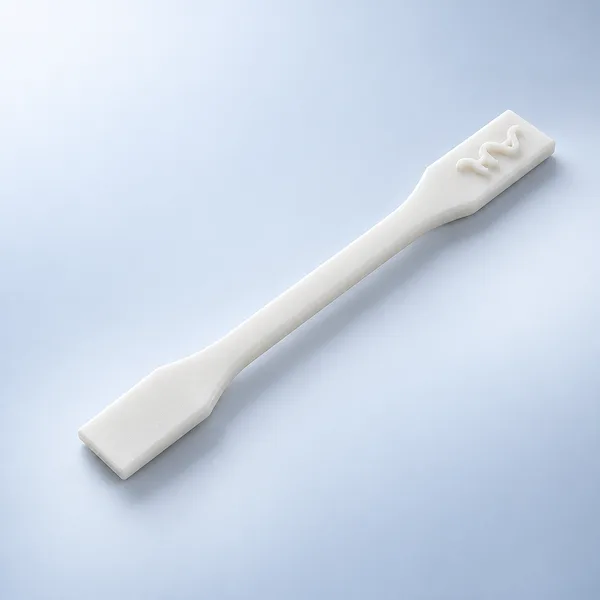
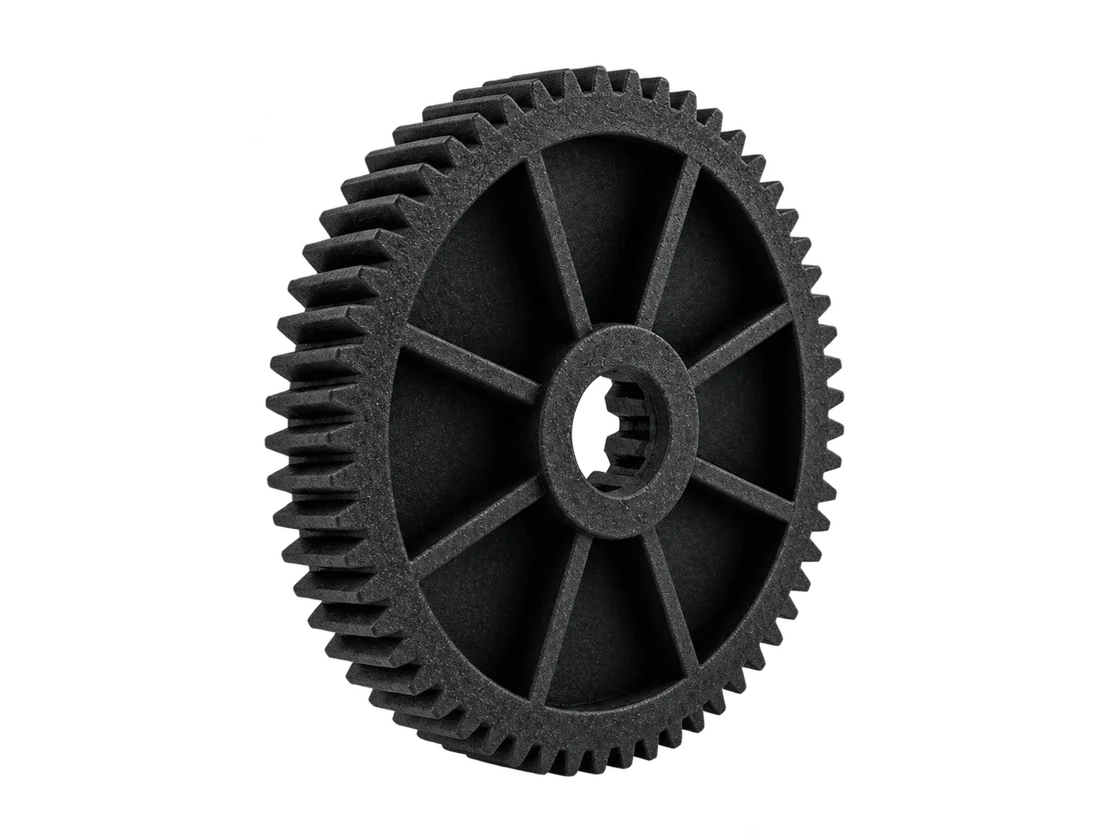
Nylon PA 12 White

Nylon PA 12 White

Nylon PA 12 White

SLS 3D Printing

Example parts
Snap-fit covers, connector housings, and functional prototypes.
Selection focus
General-purpose nylon with a balance of stiffness and toughness. Choose white when the part will be dyed or color matched.
Learn more
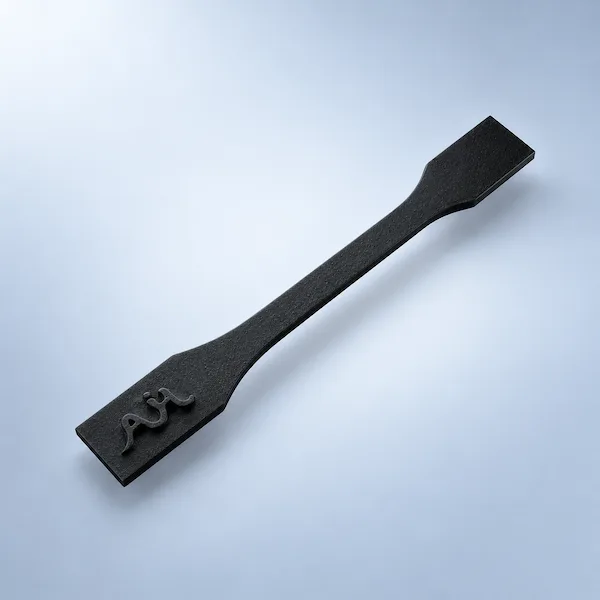
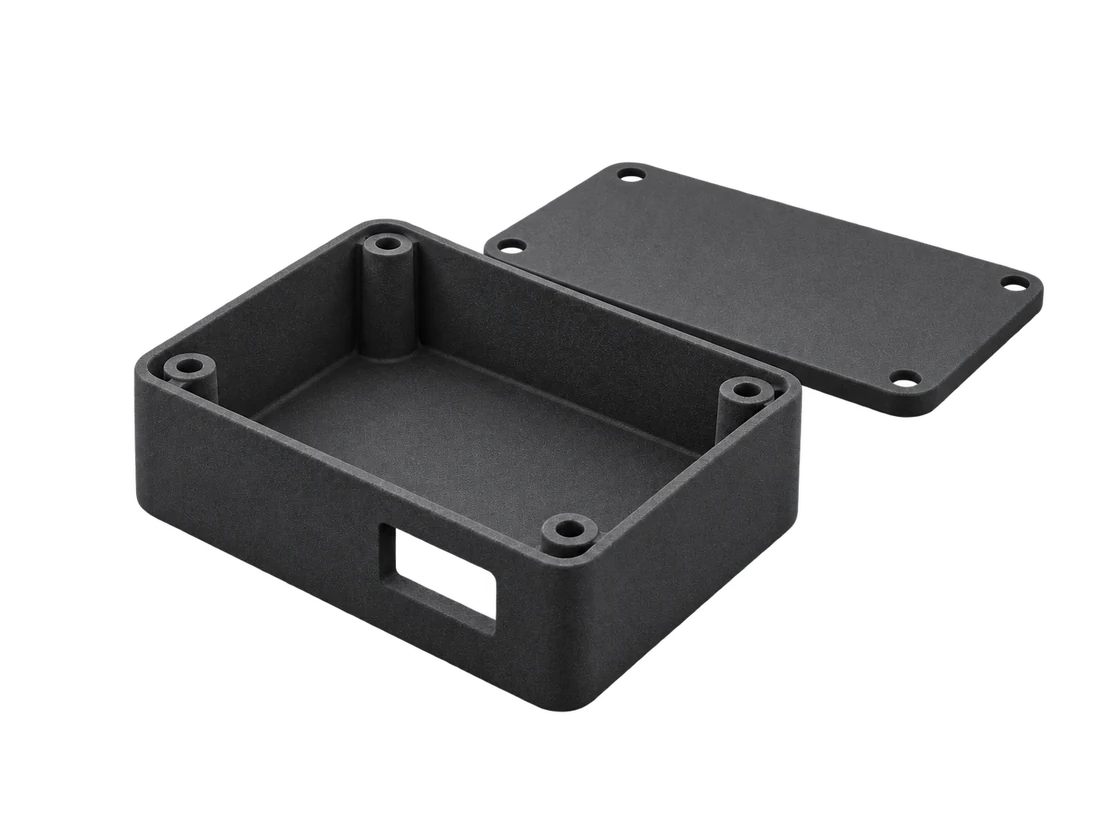
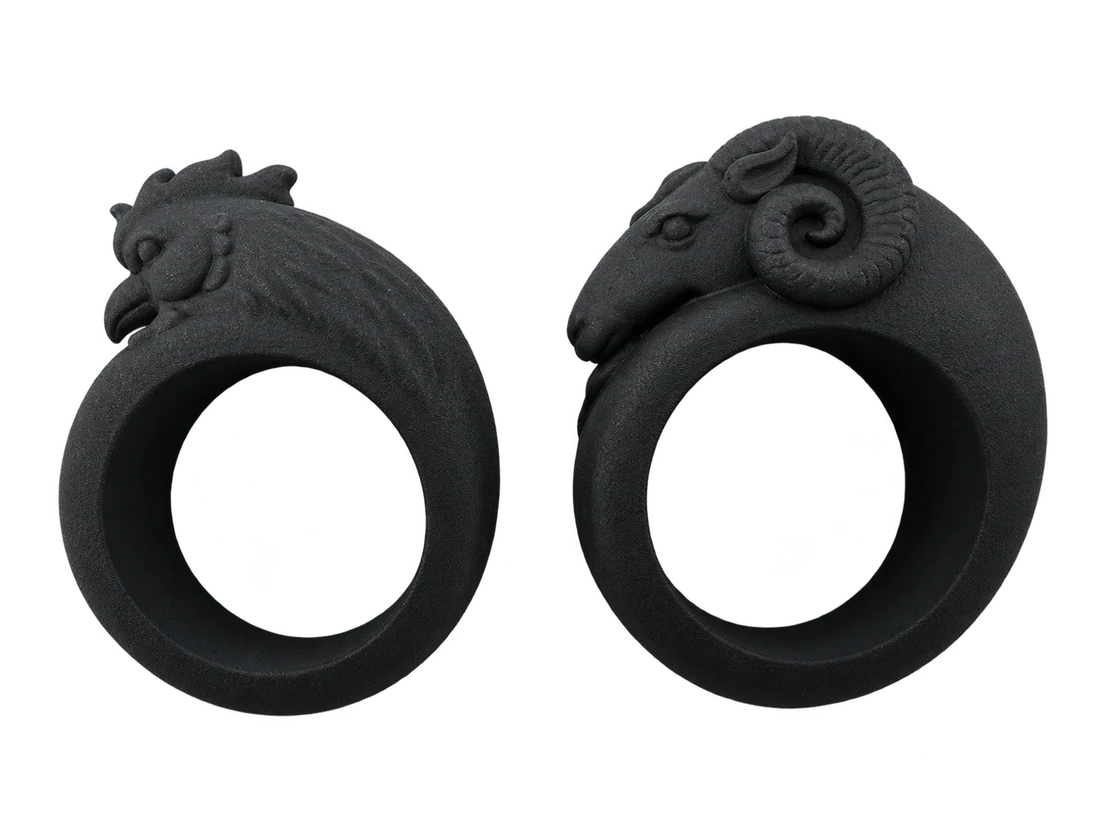
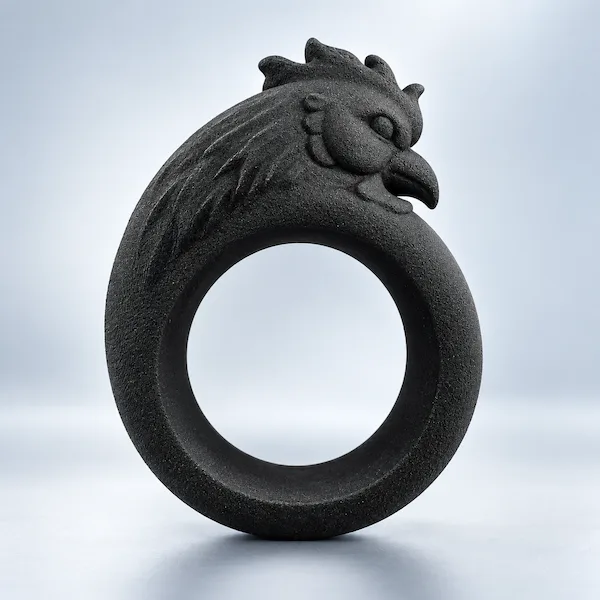
Nylon PA 12 Black

Nylon PA 12 Black

SLS 3D Printing

Example parts
Camera housings, electronics enclosures, and assembly jigs.
Selection focus
Balanced stiffness and toughness for functional housings. Choose black when the part needs a dark appearance.
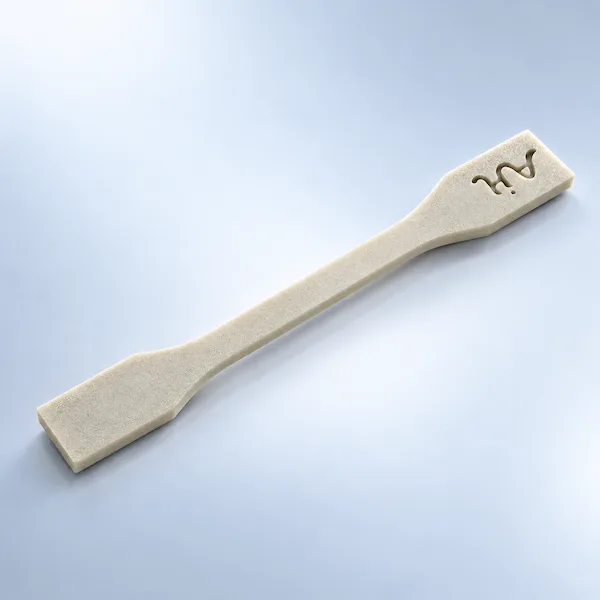
Learn more
Nylon PA 12 Glass-filled White

SLS 3D Printing

Example parts
Locating fixtures, inspection nests, and equipment covers.
Selection focus
Higher stiffness and dimensional stability for tooling. Review unfilled grades for parts that need repeated flexing.
Learn more

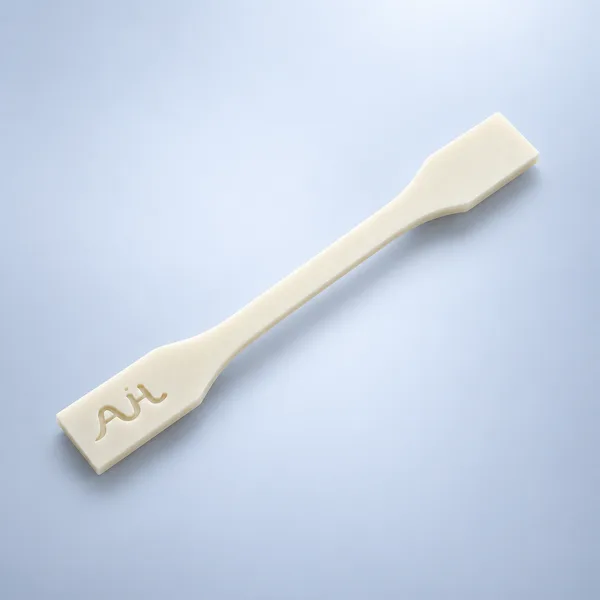
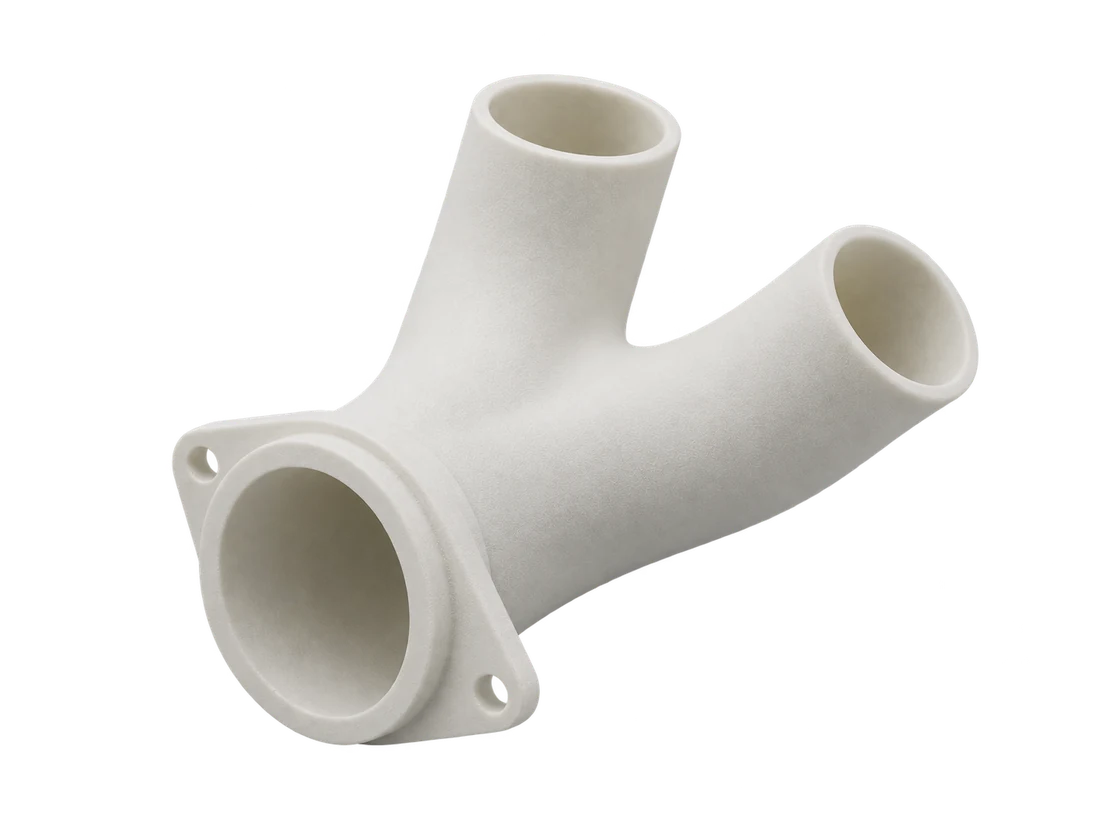
Nylon PA 11 White

Nylon PA 11 White

Nylon PA 11 White

SLS 3D Printing

Example parts
Snap-fit clips, hinge prototypes, and impact-resistant covers.
Selection focus
Ductility and impact resistance for features that need to flex during assembly. Validate hinge geometry and cycle life.
Learn more
Nylon PA 11 Black

Nylon PA 11 Black

SLS 3D Printing

Example parts
Retaining clips, latch prototypes, and protective covers.
Selection focus
Ductility and impact resistance for flexible features in a black finish. Verify the fit and deflection of clips in the assembly.
Learn more
Nylon PA 6 Glass-filled Black

SLS 3D Printing

Example parts
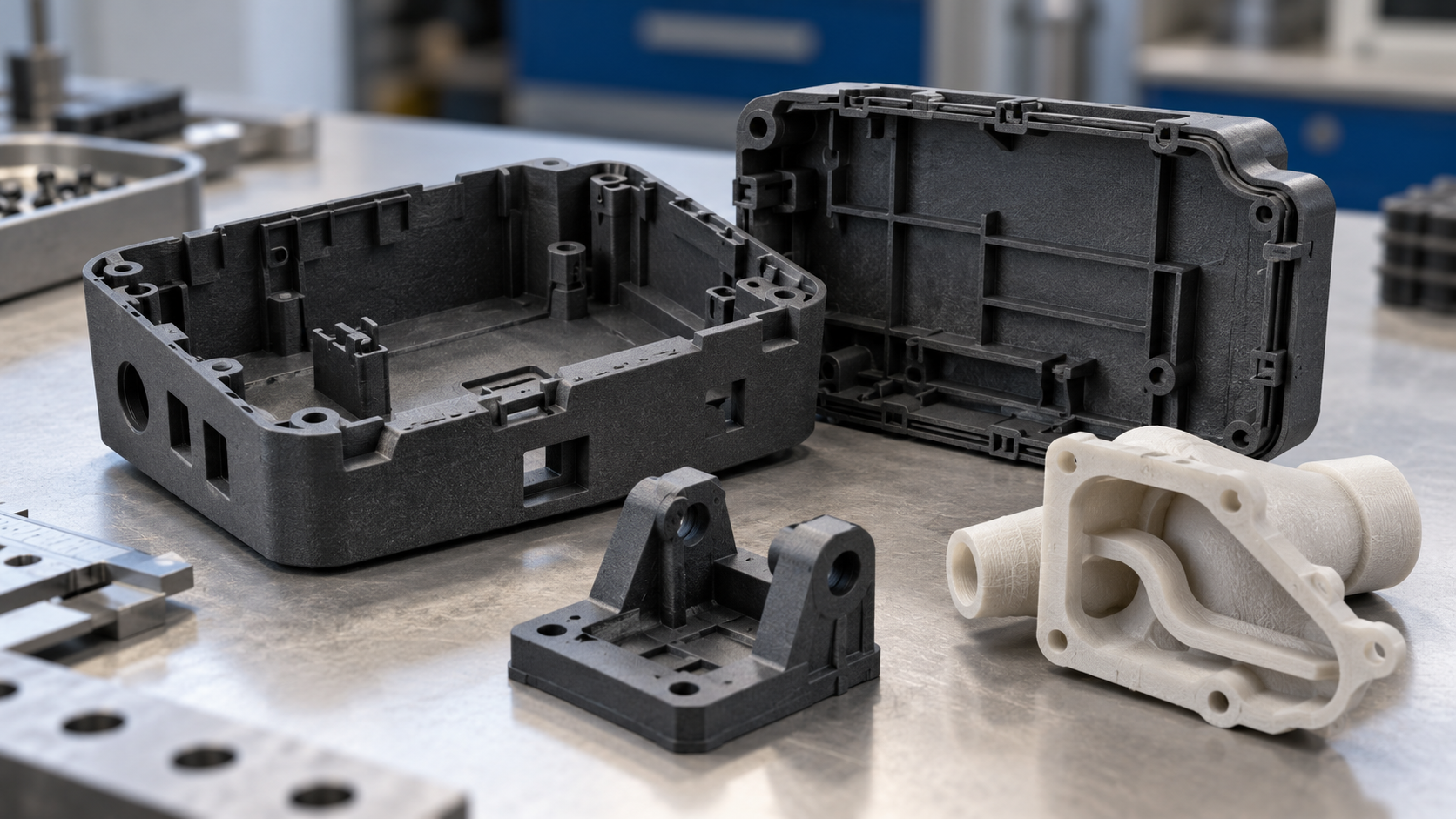
Rigid electronics housings, fixture bodies, and intake manifold prototypes.
Selection focus
Prioritize rigidity and heat resistance. Review moisture exposure and dimensional requirements for tight fits.
Learn more
TPU White

SLS 3D Printing

Example parts
Vibration pads, flexible bumpers, and gasket prototypes.
Selection focus
Choose for flexibility and abrasion resistance. Confirm hardness and compression behavior for the intended load.
Learn more
Polypropylene Glass-filled

SLS 3D Printing

Example parts
Chemical-handling covers, equipment guards, and lightweight housing prototypes.
Selection focus
Choose for low density and chemical resistance. Check the exact grade against the fluid, service temperature, and load.
Learn more

Can’t Find Your Material?

Tell our engineers which material you need and how the part will be used.

SLS 3D Printing Surface Finishes

See how SLS nylon looks after powder removal, dyeing, media tumbling and vapor smoothing. Explore 3D Plus finishing for more options.

As-Sintered (Unpolished)

Standard finish
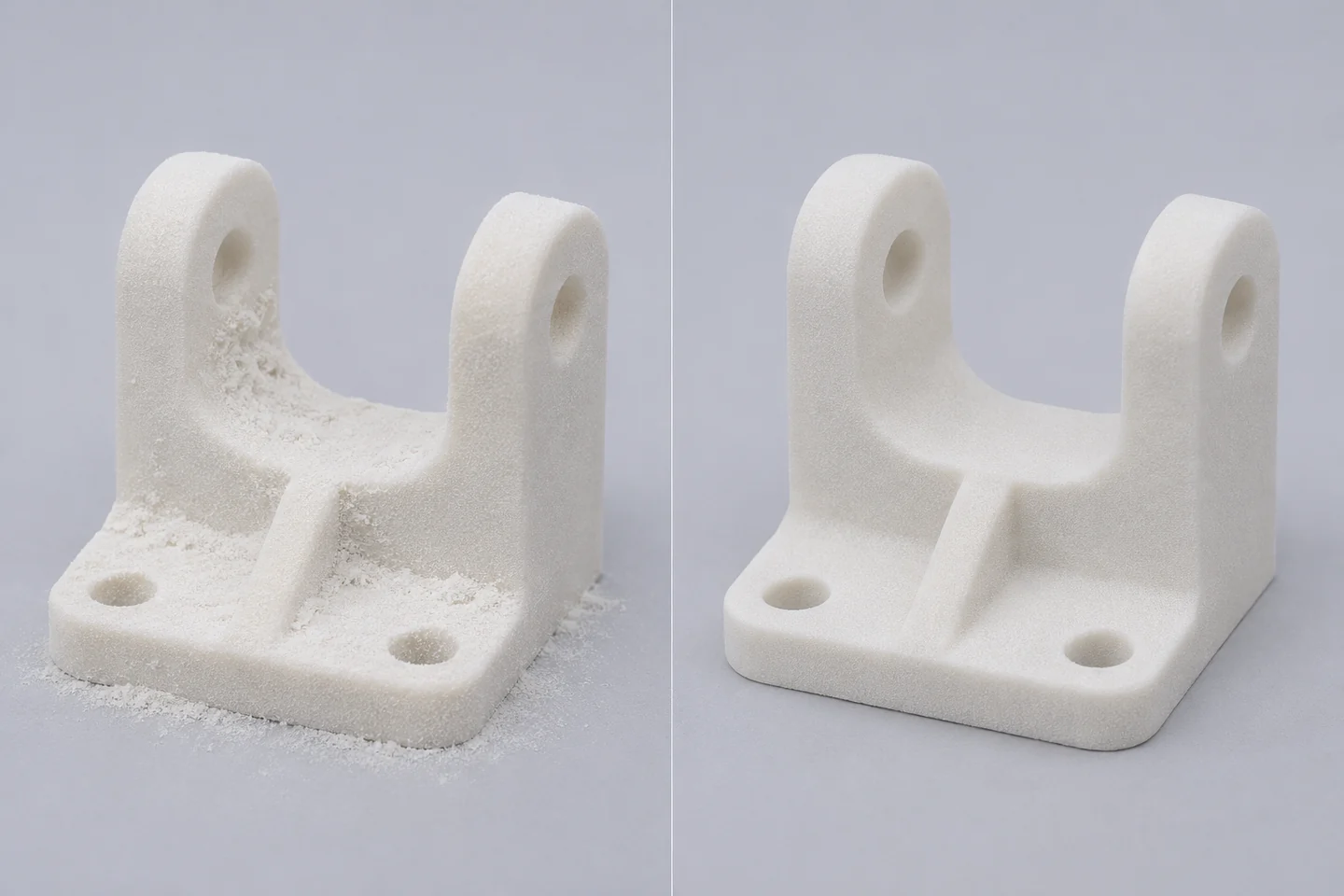
White SLS nylon bracket with loose powder in the recesses before cleaning and a clean matte surface after depowdering.
BeforeLoose powder on the part AfterClean, matte surface

Loose powder is removed from accessible surfaces and recesses. The cleaned part retains its natural color and fine, grainy texture.

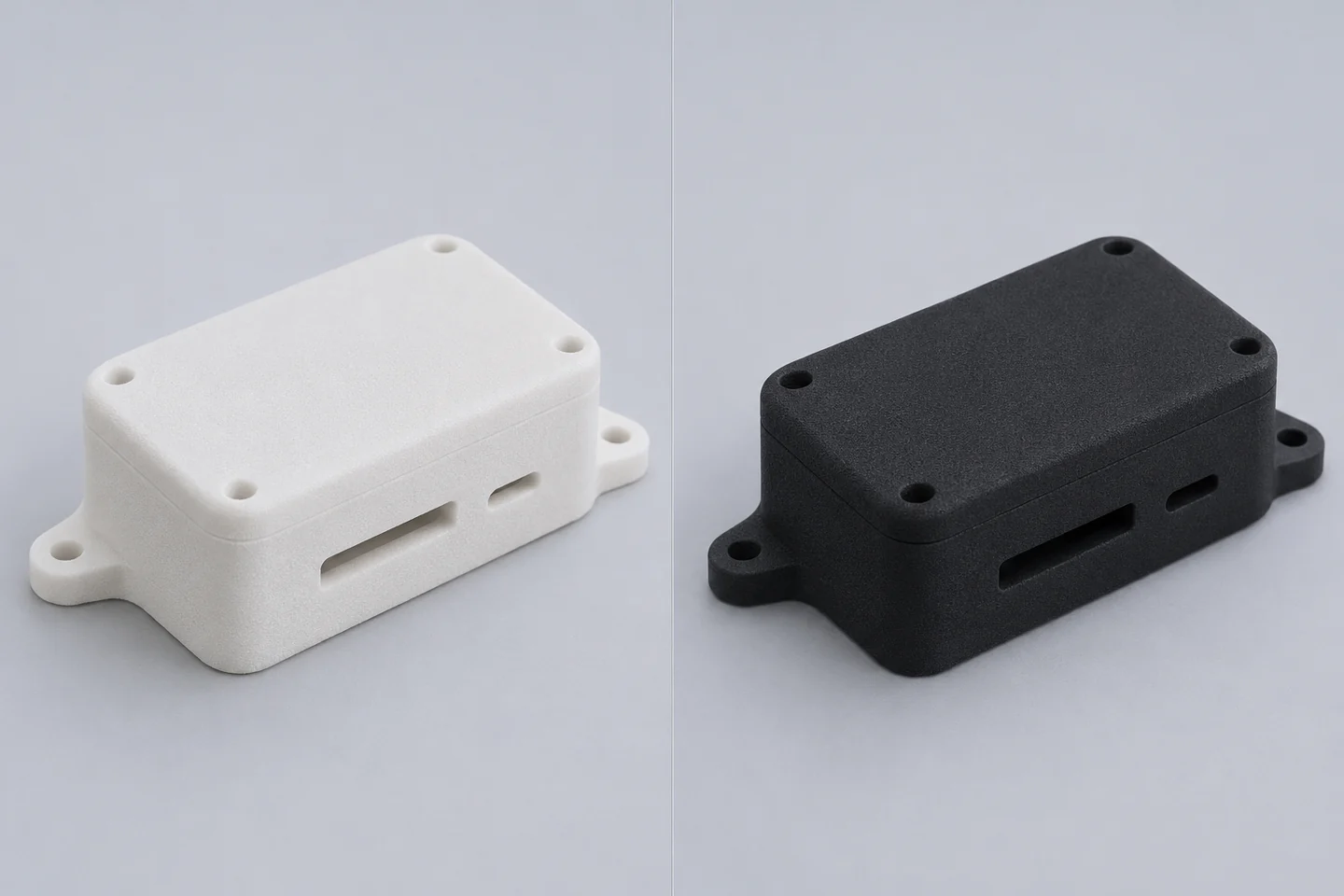
Dyeing

Optional finish
The same SLS nylon enclosure in natural white before dyeing and matte black after immersion dyeing.
BeforeNatural white nylon AfterBlack-dyed nylon

Immersion dyeing adds color to compatible nylon while retaining the as-sintered texture. Confirm the available colors for your material grade.

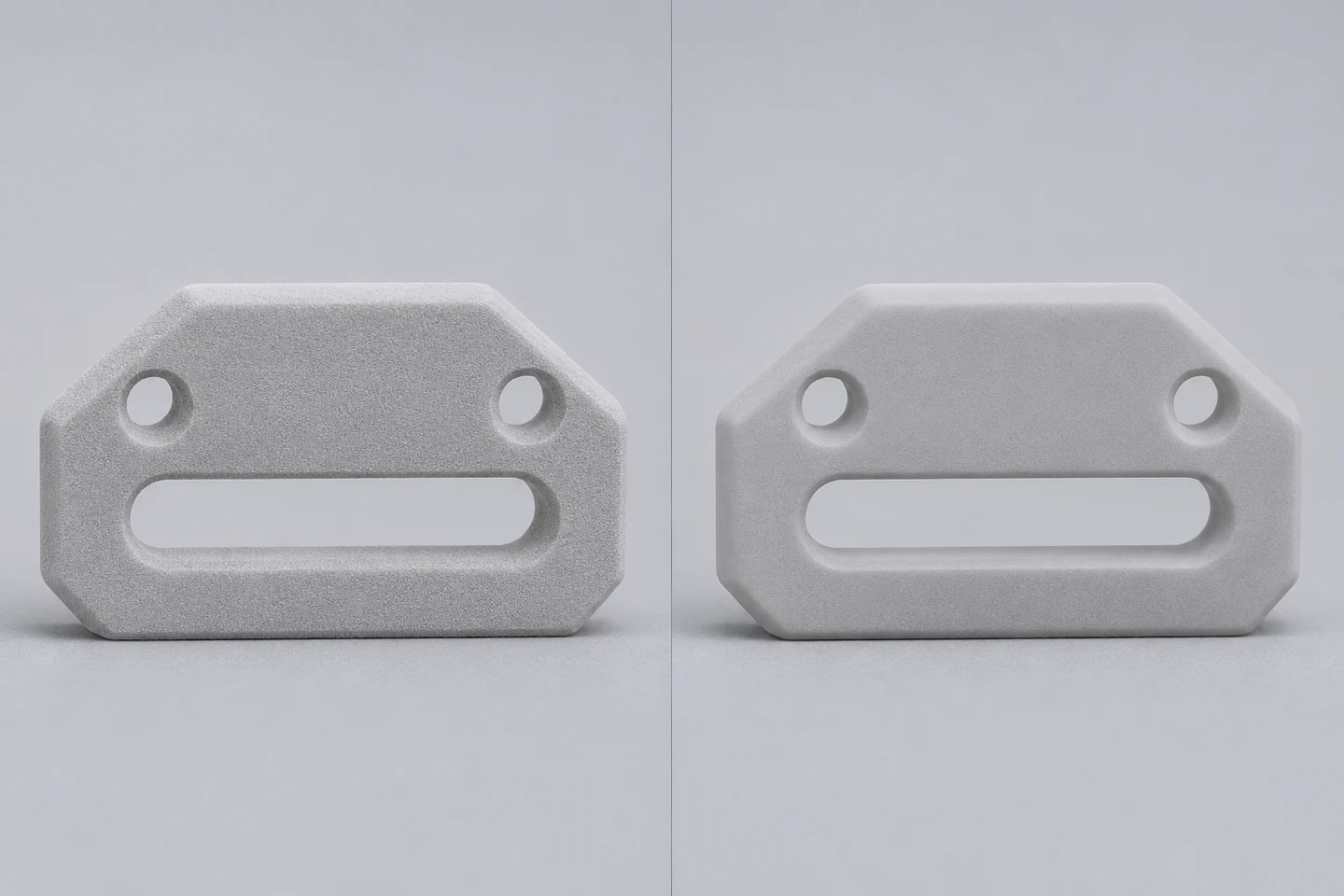
Media Tumbling

Optional finish
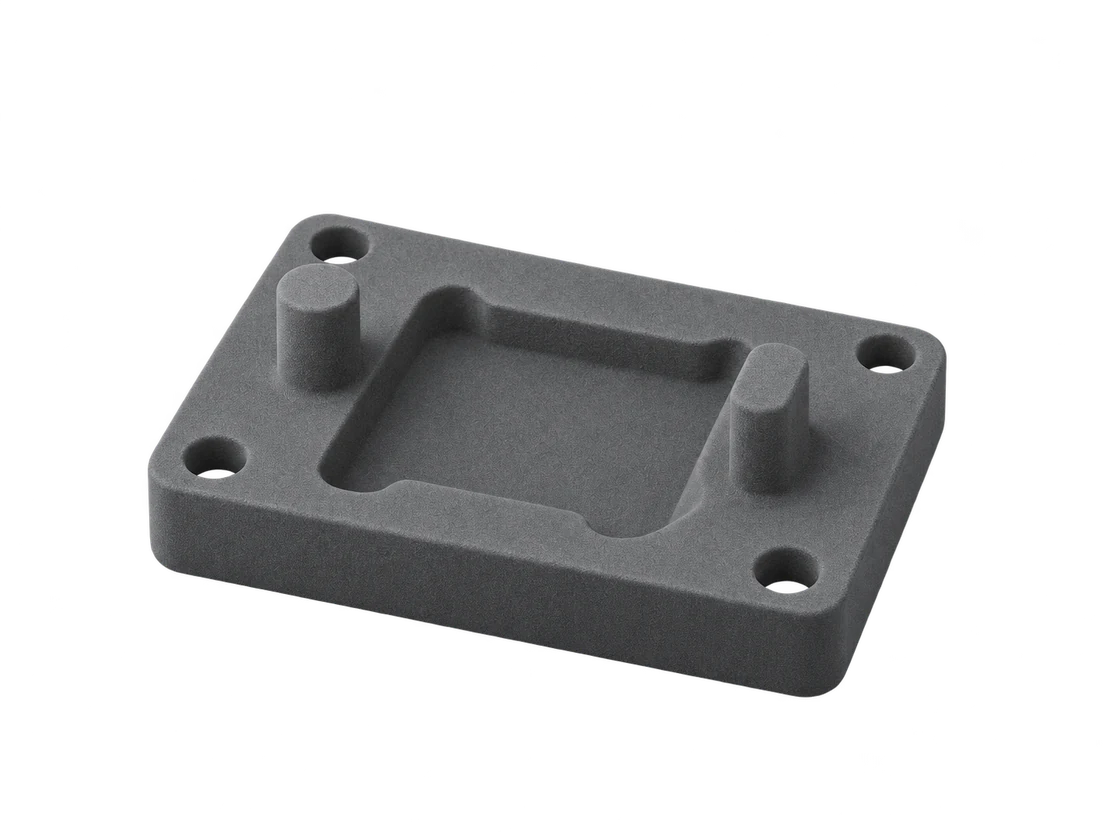
Slotted SLS mounting plate with a grainy matte surface before tumbling and a smoother matte finish after tumbling.
BeforeGrainy matte surface AfterSmoother matte surface

Abrasive media smooths exposed surfaces and can slightly round edges. Flag sharp edges and tight fits on your drawing.

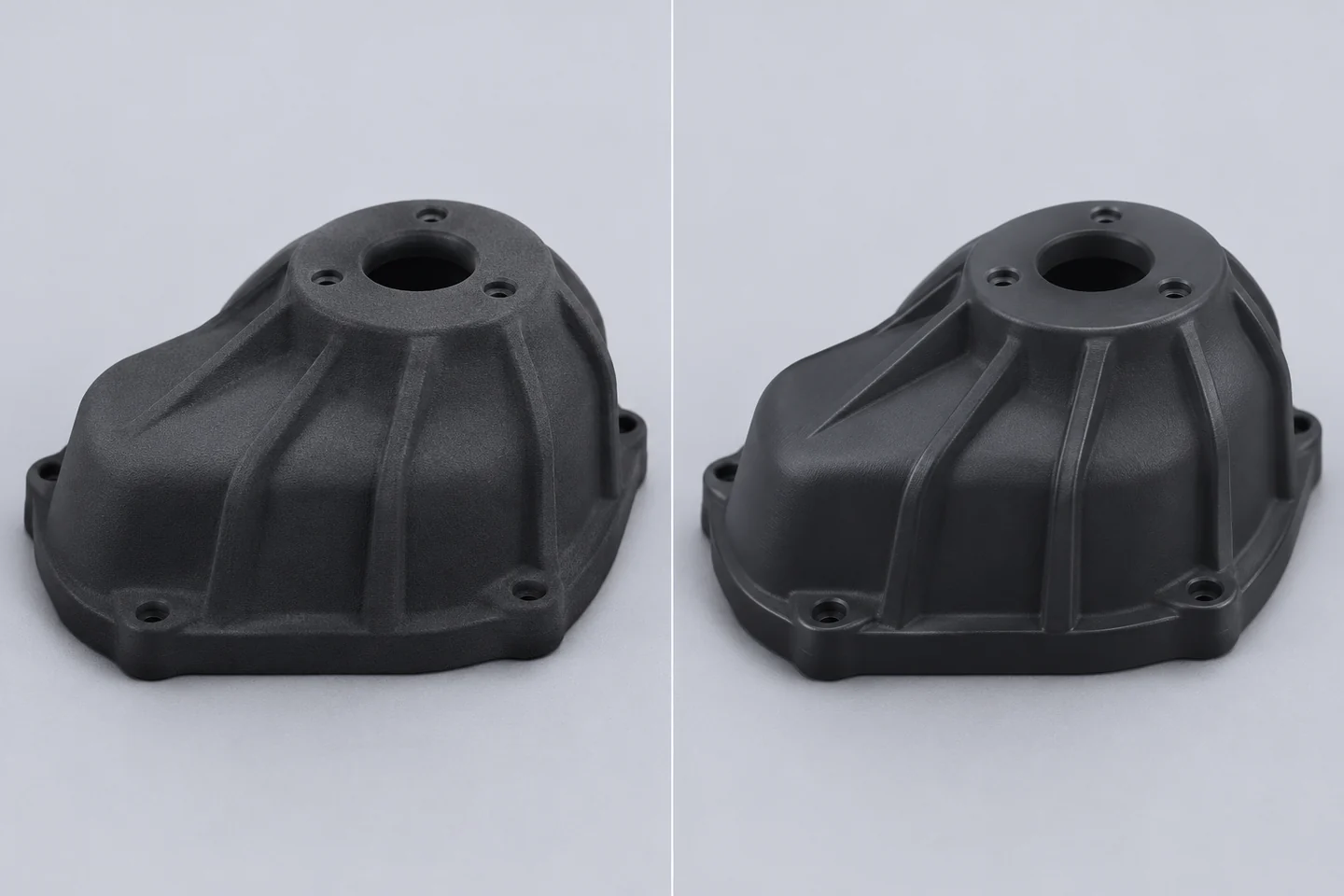
Vapor Smoothing

Optional finish
Dark SLS nylon cover with a matte texture before vapor smoothing and a smoother satin finish afterward.
BeforeMatte powder-bed texture AfterSmoother satin finish

Controlled solvent vapor smooths the surface of compatible nylon. The final sheen depends on the material grade and part geometry.

Get the Right Finish for Your Part

Include your target color or sheen and mark cosmetic faces and critical fits on your drawing.

Discuss Your Finish

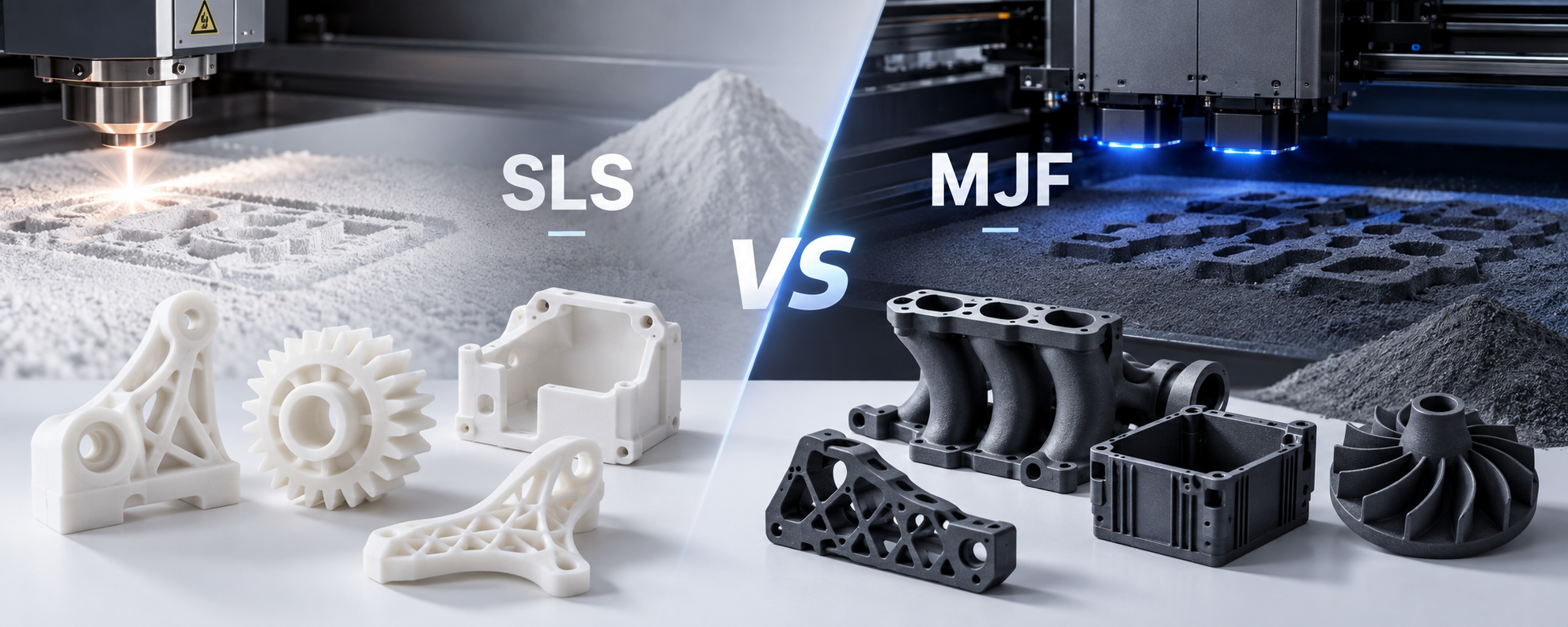
SLS / MJF vs Other 3D Printing Processes

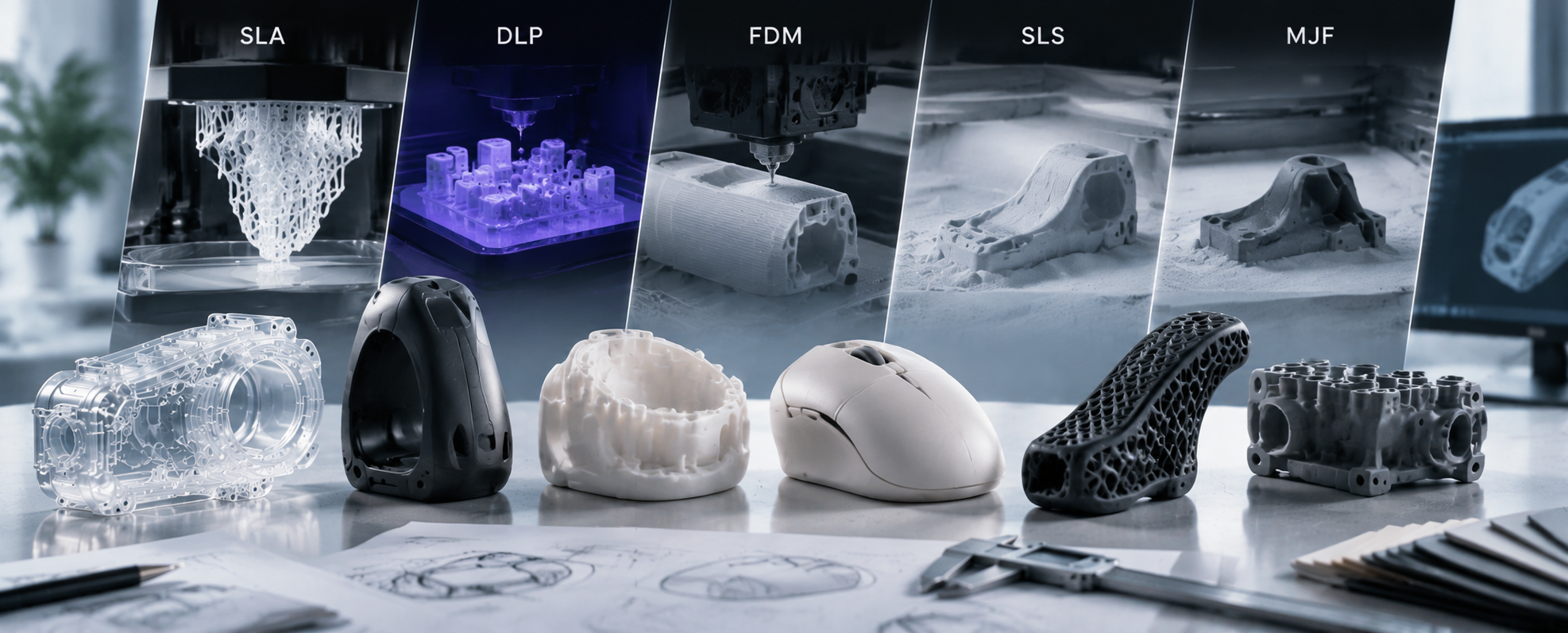
Compare SLS and MJF powder-bed printing with SLA, DLP and FDM by part detail, material performance and finished-part cost.

Swipe horizontally to view the full comparison.

SLS / MJF vs SLA
Comparison FactorSLS / MJF Nylon PrintingSLA Resin Printing
XY DetailFine text and small grooves can lose definitionFine features and smooth curves
Typical Tolerance±0.3 mm or ±0.3%
Planning tolerance
±0.2 mm on well-supported features
Max Build EnvelopeSLS: 645 × 325 × 520 mm
MJF: 380 × 284 × 380 mm
Planning dimensions
Up to 1,400 × 700 × 500 mm
X × Y × Z
Layer ThicknessConfirm for the selected machine and material0.05–0.25 mm
G1400-P+ equipment reference
Build Speed & Batch Throughput3D nesting for batch production
Cooling adds time
Longer scan paths take more time
Functional PerformancePA12 for functional housings and snap-fits
Grade determines stiffness and toughness
Properties vary by resin grade
Check load and flex requirements
Surface FinishSLS: Matte, slightly grainy
Vapor smoothing or tumbling
MJF: Fine grain
Dyeing or vapor smoothing
Smooth as printed
Sanding, painting or coating
Supports & Post-ProcessingPowder bed supports parts
No separate supports
Trapped powder needs an escape path
Supports required
Contact points can go on non-cosmetic faces
Finished-Part CostDense builds can lower unit cost
Depends on packing and finish
Cost varies with scan time, resin and finish
Lead TimeExpress from 48 hours
Standard options: 72 hours or 5 days
24, 48 or 72 hours after file approval
Depends on part size and finishing
SLS / MJF vs DLP
Comparison FactorSLS / MJF Nylon PrintingDLP Resin Printing
XY DetailFine text and small grooves can lose definitionCrisp XY detail
Pixel edges on some curves
Typical Tolerance±0.3 mm or ±0.3%
Planning tolerance
±0.2 mm on supported geometry
Max Build EnvelopeSLS: 645 × 325 × 520 mm
MJF: 380 × 284 × 380 mm
Planning dimensions
Depends on the assigned machine
Typically desktop to mid-size platforms
Layer ThicknessConfirm for the selected machine and materialConfirm for your project
Build Speed & Batch Throughput3D nesting for batch production
Cooling adds time
Parts share each layer exposure
Functional PerformancePA12 for functional housings and snap-fits
Grade determines stiffness and toughness
Standard and tough resins serve different uses. Verify the grade for repeated flex or impact.
Surface FinishSLS: Matte, slightly grainy
Vapor smoothing or tumbling
MJF: Fine grain
Dyeing or vapor smoothing
Smooth as printed
Vapor polishing or coating available
Supports & Post-ProcessingPowder bed supports parts
No separate supports
Trapped powder needs an escape path
Supports required on overhangs
Wash, post-cure and remove supports
Finished-Part CostDense builds can lower unit cost
Depends on packing and finish
Packed builds can lower unit cost
Lead TimeExpress from 48 hours
Standard options: 72 hours or 5 days
From 48 hours
SLS / MJF vs FDM
Comparison FactorSLS / MJF Nylon PrintingFDM Filament Printing
XY DetailFine text and small grooves can lose definitionNozzle width limits fine text and narrow grooves
Typical Tolerance±0.3 mm or ±0.3%
Planning tolerance
±0.5 mm or ±0.5%
For FDM-appropriate geometry
Max Build EnvelopeSLS: 645 × 325 × 520 mm
MJF: 380 × 284 × 380 mm
Planning dimensions
Varies by machine
Large-format options on request
Layer ThicknessConfirm for the selected machine and materialVaries by machine and setup
Build Speed & Batch Throughput3D nesting for batch production
Cooling adds time
Quick iterations for simple parts
Infill and supports affect print time
Functional PerformancePA12 for functional housings and snap-fits
Grade determines stiffness and toughness
Thermoplastics for fixtures and functional prototypes
Often weaker across layers
Surface FinishSLS: Matte, slightly grainy
Vapor smoothing or tumbling
MJF: Fine grain
Dyeing or vapor smoothing
Visible layer lines
Optional sanding or coating
Supports & Post-ProcessingPowder bed supports parts
No separate supports
Trapped powder needs an escape path
Breakaway or soluble supports for overhangs
No UV post-cure
Finished-Part CostDense builds can lower unit cost
Depends on packing and finish
Often economical for simple parts
Finishing can add cost
Lead TimeExpress from 48 hours
Standard options: 72 hours or 5 days
24–48 hours depending on part size

SLS and MJF are grouped for nylon part selection. Build envelopes, available grades and finishing options vary by process. Final tolerances, price and lead time depend on your CAD, material and finishing requirements.

Aihfabs’ SLS Production Capacity

Our SLS production covers functional prototypes and short-run plastic parts.

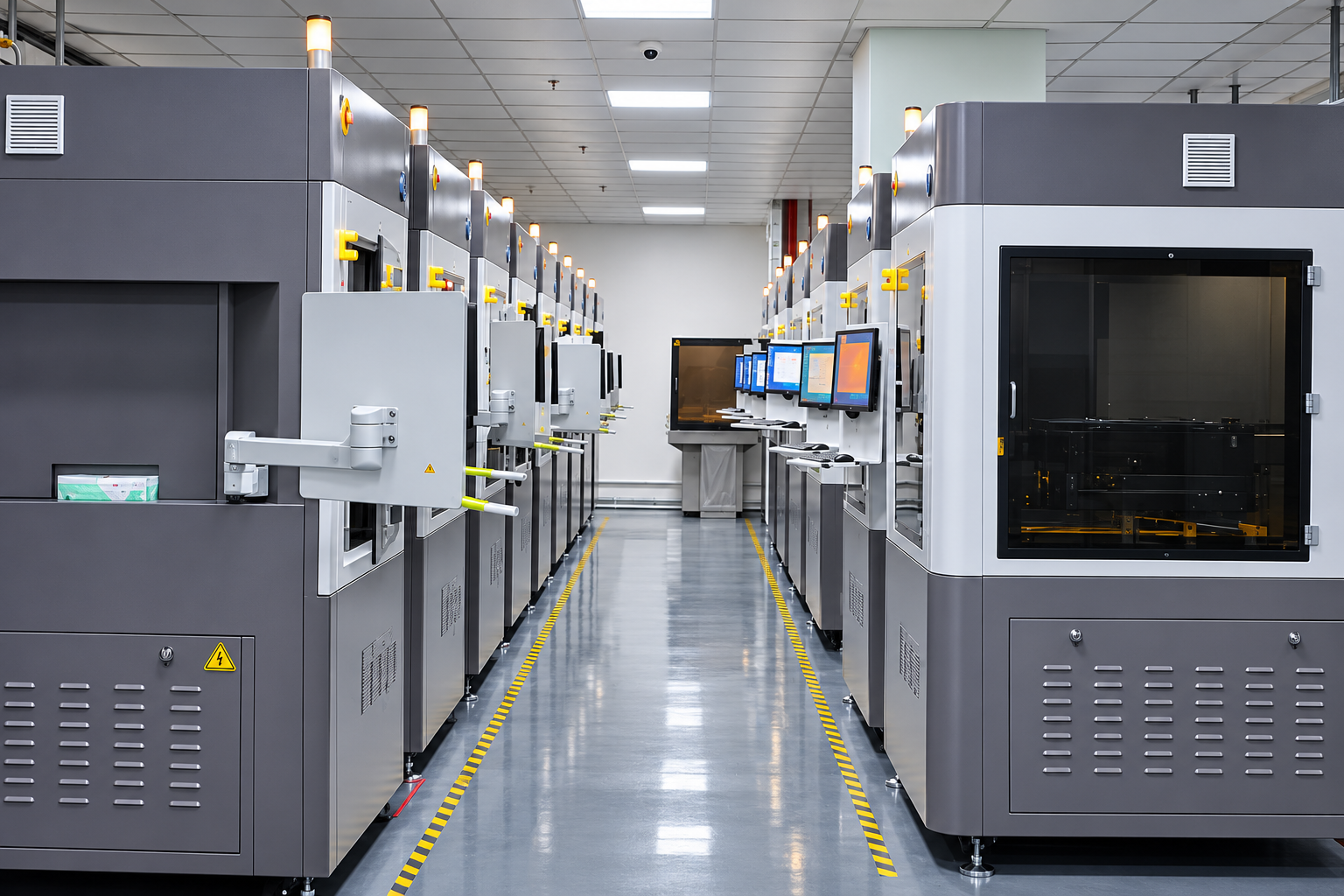
SLS Printing Equipment

We review part orientation, packing density and powder removal when planning each build.

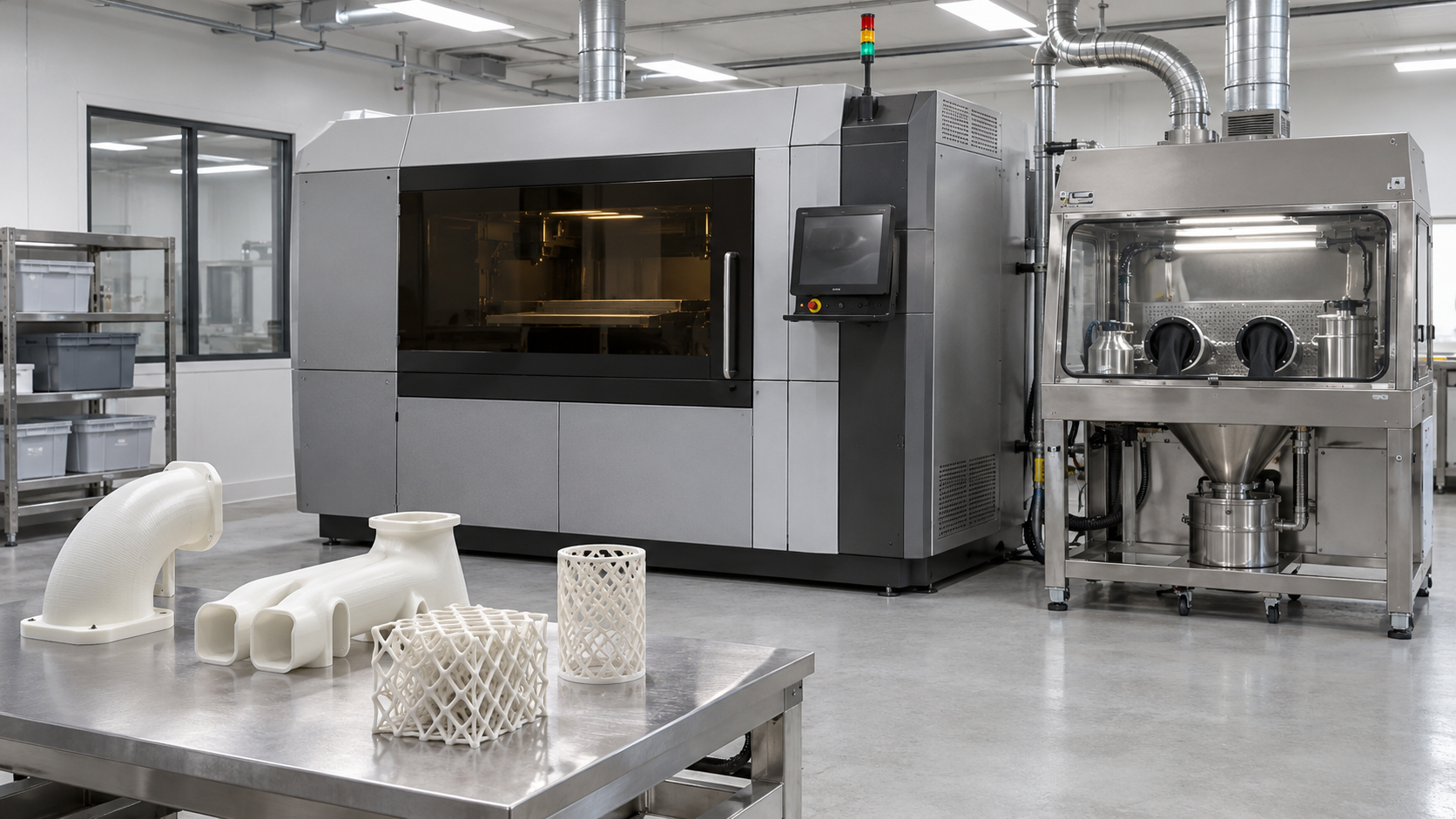
SLS factory production line, AI-enhanced from the supplied photograph
Equipment
Industrial SLS powder-bed systems; model assigned by material and build size.
Maximum Build Envelope (X × Y × Z)
Up to 645 × 325 × 520 mm; material dependent.
Supported Materials
PA12 (white / black), PA11 (white / black), glass-filled nylon, carbon-filled nylon, TPU and glass-filled PP. See material catalog below.
Layer Thickness
0.10–0.15 mm typical; confirmed by material and build plan.

Industrial SLS Equipment · Build Volume (X × Y × Z)

AIHFABS SLS Production

Up to 645 × 325 × 520 mm

Usable part size depends on material, orientation and build planning.
EOS P 770 · Manufacturer Reference

700 × 380 × 580 mm for PA 2200

Manufacturer reference specifications ↗

Equipment & Manufacturer Information

AI-generated illustration of an SLS printer, powder handling station and nylon samples

SLS Printing & Powder Handling

AI-generated process illustration.

Send your CAD, quantity and finish requirements for a production review.

Upload Your Drawings

SLS 3D Printing
Across Industries

SLS nylon printing produces functional prototypes, assembly tooling and short-run parts. The powder bed supports parts during printing, so features such as clips and ducts can be built without separate supports.

Explore All Industries

Share your critical fits, expected loads and finish requirements so we can review material selection and part geometry.

Robotics

Gripper fingers and sensor brackets

Explore

Automotive

Air duct prototypes and trim clips

Explore

Electronics

Sensor housings and cable guides

Explore

Aerospace

Assembly fixtures and fit-check parts

Explore

Medical Devices

Device enclosure prototypes and bench fixtures

Explore

Consumer Goods

Snap-fit covers and functional prototypes

Explore

Selective Laser Sintering (SLS)
3D Printing Cost

See what affects your quote for SLS nylon parts and how to manage unit cost.

SLS Project Examples

Solid sample estimates in USD

Enclosure Prototype

Nylon PA 12 White
Estimated Unit Price
$20.47/ part
Example Dimensions
60 × 40 × 20 mm
Order Quantity
1 part
Optional Finishing to Review

Dyeing or vapor smoothing.

Snap-Fit Prototype

Nylon PA 11 White
Estimated Unit Price
$56.31/ part
Example Dimensions
80 × 50 × 15 mm
Order Quantity
1 part
Optional Finishing to Review

Dyeing; review fit after finishing.

Estimated Unit Price
$42.49/ part
Example Dimensions
75 × 45 × 25 mm
Order Quantity
1 part
Optional Finishing to Review

Tapping or threaded inserts.

Prices use one solid rectangular sample at each listed size, calculated with the catalog pricing rules. Estimates exclude optional finishing and shipping. Upload your CAD file for a quote based on actual part volume.

View Quote Basis & Scope

Standard processing includes powder removal and blasting. Specify any optional finish, inspection needs and delivery requirements when requesting a quote.

What Changes Your Quote?

How to Reduce Purchasing Cost

Quote factor

Material & Geometry

Powder grade, part volume, build height and packing density.

Cost-saving option

Review Solid Sections

Consider hollowing thick sections where strength allows. Include openings for powder removal.

Quote factor

Finish & Inspection

Dyeing, vapor smoothing, critical fits and inspection requirements.

Cost-saving option

Mark Critical Features

Apply tighter tolerances and extra finishing to the features that need them.

Quote factor

Quantity & Lead Time

Order quantity, build scheduling and requested turnaround.

Cost-saving option

Compare Batch Options

Request unit prices at your planned quantities and compare standard and express lead times.

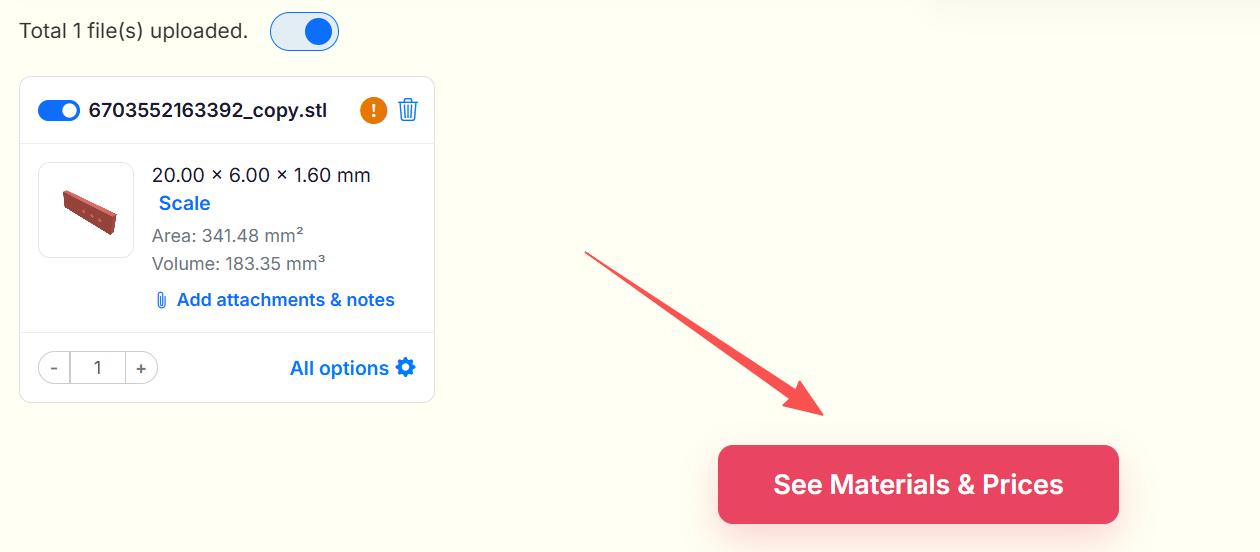
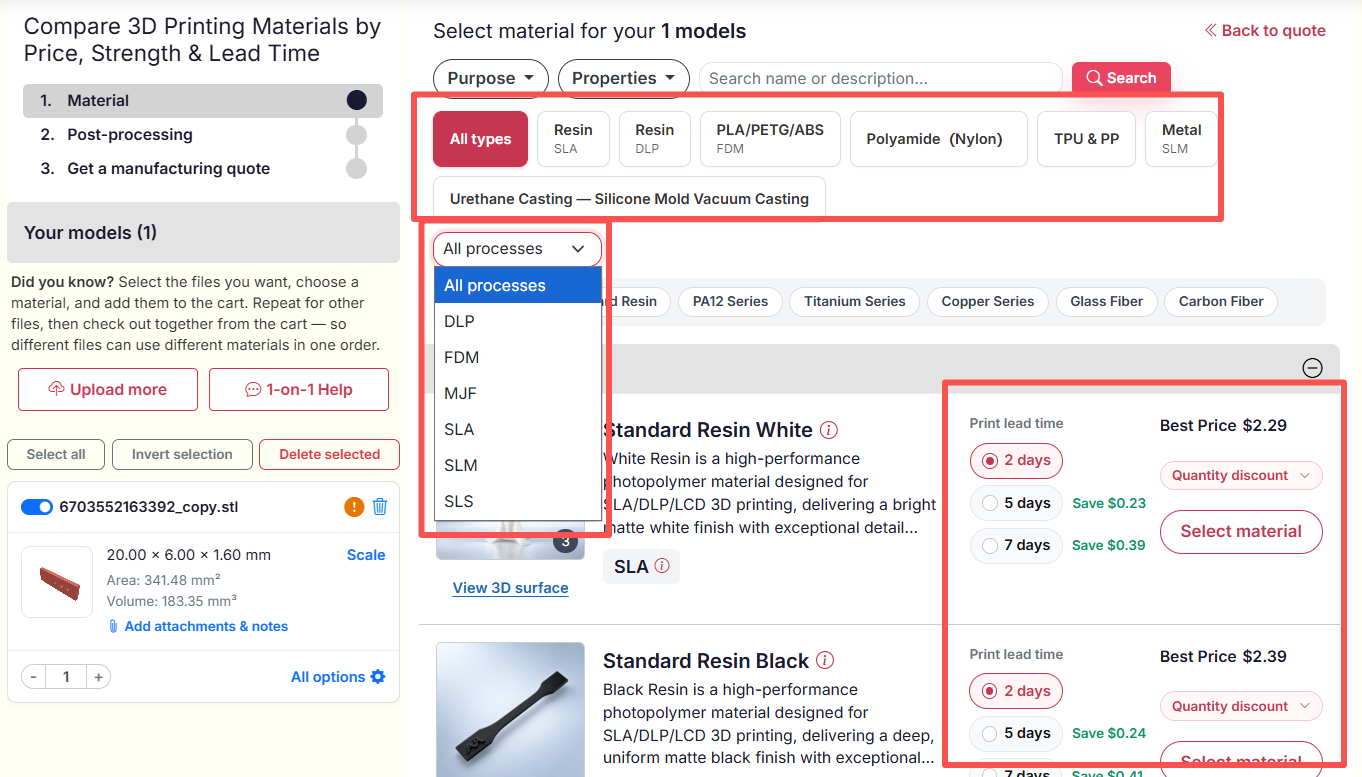
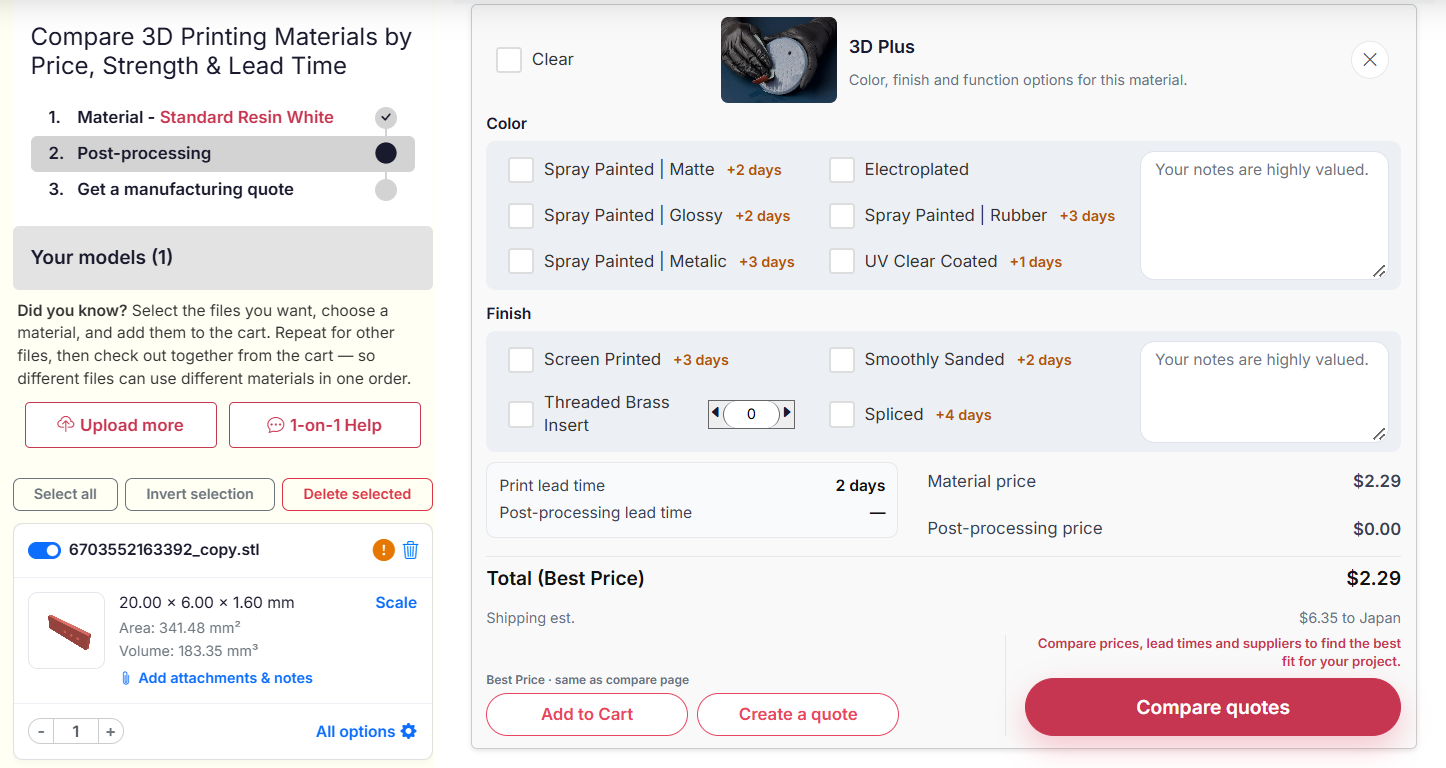
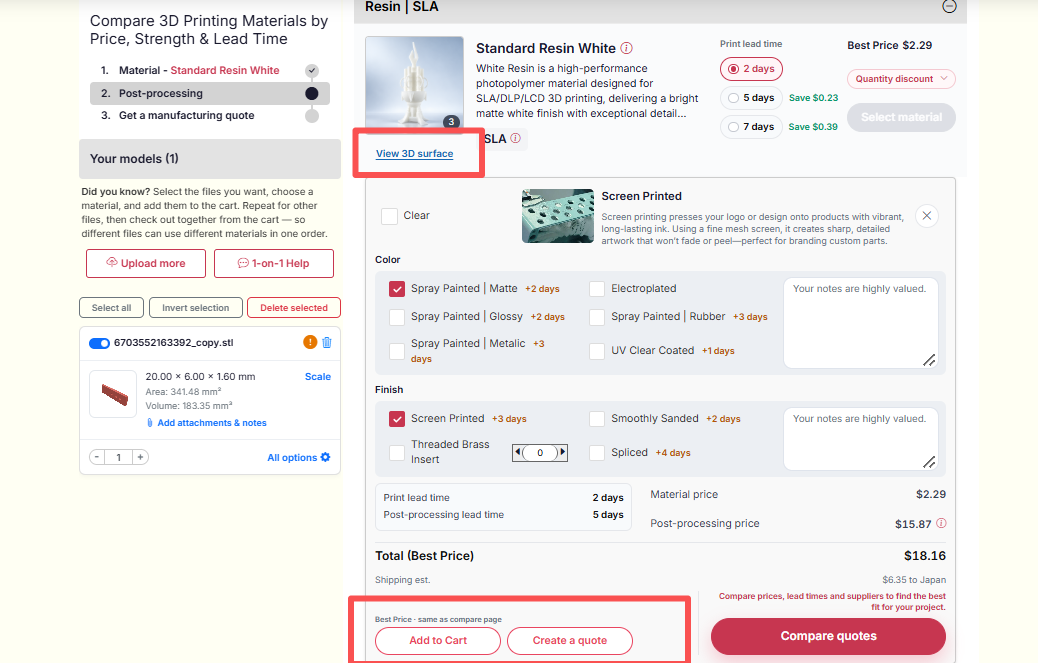
Upload, Compare & Request Your SLS Quote

From 3D files to a quote: choose materials, configure your parts and compare prices in one online workflow.

Explore the quoting steps

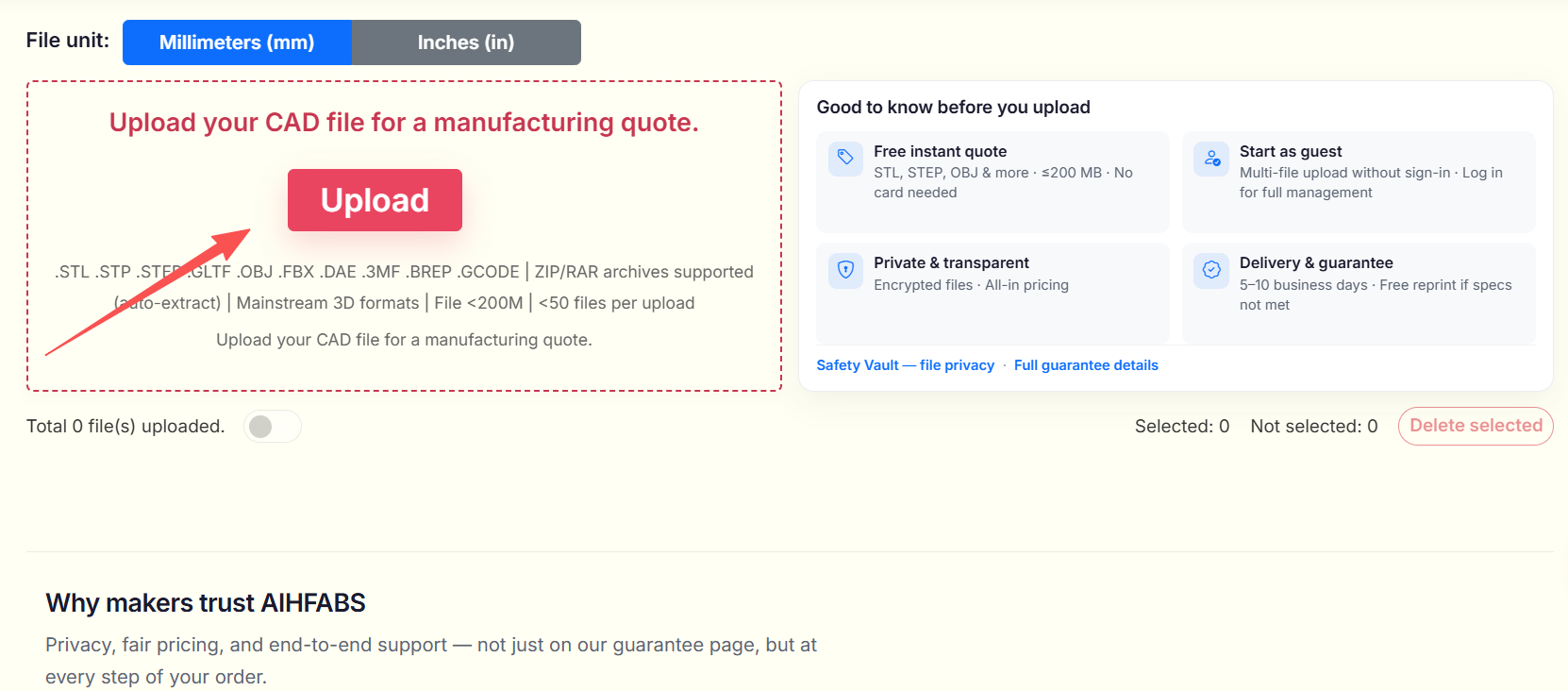
AIHFABS CAD upload interface with file-unit selection and an Upload button
Upload Your CAD FileChoose millimeters or inches before uploading. Multiple models can be uploaded together.

SLS 3D Printing FAQs

Does SLS need support structures?

Almost never. The unsintered powder holds the sintered nylon part. You still need escape holes on closed volumes.

SLS or MJF for nylon?

Both make durable PA12. MJF is often quicker on dense production nests; SLS is strong when the powder grade or the envelope fits that cell better. Upload once and we will pick a route.

What quality should I expect from SLS printed parts?

SLS printed parts are tough and slightly grainy as-sintered. Plan ±0.3 mm or ±0.3% on typical geometry. Dye and vapor smooth improve cosmetics without changing the bulk nylon much; polishing can round edges and should be called out when a sharp edge is functional.

What is glass filled nylon SLS used for?

Glass filled nylon SLS is for stiff housings, jigs, and covers that must not sag. It is the wrong grade for living hinges and high-elongation snaps — use unfilled SLS nylon or TPU there.

Do you offer SLS post processing?

Yes. Depowder and blast are standard. Dye, tumble, vapor smooth, tap, and paint are quoted when you list them. Color and coating options are on 3D Plus finishing.

What tolerance should I plan?

±0.3 mm or ±0.3%, whichever is greater, on typical SLS geometry. Tighter fits can be reviewed with a drawing and optional machining.

Typical lead time?

Express from 48 hours; standard tiers around 72 hours or 5 business days depending on cake schedule.

SLS 3D Printing Services — engineering review before production

Use these process-specific checks when preparing your model, drawing and quote request. The confirmed quotation and approved drawing define the requirements for your part.

Powder access and nylon behavior

Unsintered powder supports the build but must be removed from the finished part. Provide cleaning access to enclosed spaces and long channels. Check moisture exposure, wall transitions and the exact nylon grade when dimensions or mechanical behavior matter.

Clips, sealing and assembly

Snap-fits need strain and fatigue review, not just a minimum wall check. Powder-bed texture may matter on sealing surfaces and sliding contacts. Discuss inserts, machined bores or finishing for interfaces that need a controlled fit.

Acceptance checklist

Confirm PA grade, dye or smoothing requirements, powder-removal access and critical dimensions after finishing. Evaluate assembly and repeated flexing on a sample for clips or wearable components.

需要類似的 3D 列印或 CNC 零件?

AIHFABS 根據 CAD 上傳為定制 3D 列印與 CNC 加工報價。比較 SLA、SLS、MJF、SLM、FDM、DLP、銑削與車削,並可在同一訂單中添加蒸汽拋光、染色、陽極氧化、拋光或粉末塗裝。

即時報價

即時報價適合原型、治具、殼體與小批量。材料、工藝、數量與交期一起展示。

多種工藝選擇

材料、工藝、數量與交期一起展示,減少工程變更後再發一輪供應商郵件。

  1. 上傳文件

    上傳 STL、STEP 等常用 CAD 格式即可線上報價。

  2. 方案對比

    在同一零件上比較 3D 列印工藝與 CNC 選項。

  3. 材質與配件

    選擇聚合物或金屬,需要時再添加 3D Plus 硬體後處理。

  4. 確認訂單

    結算前查看價格與交期,特殊規格可申請人工報價。

若本頁描述的是你想再現的工藝、產業或樣品,請從上傳流程開始,把工藝與後處理與圖紙對齊。

立即報價

Cookie 政策

我們使用 Cookie 優化瀏覽體驗。繼續使用即代表您同意我們的 隱私權政策

同意

Talk to our engineers

Verification code; click to refresh