
BOM consolidation
Combine multi-part assemblies into one monolithic machined part — fewer assembly steps and less stack-up / human error.


Dedicated large-format CNC for parts typically over 1 m and 1 ton — aerospace, energy, shipbuilding, and heavy equipment.
Large Part CNC Machining is a professional manufacturing service that uses large-scale, dedicated CNC machine tools to cut workpieces that exceed the size or weight capacity of conventional equipment. Typical parts are longer than 1 meter and heavier than 1 ton, and are widely used in aerospace, energy, shipbuilding, and mining machinery.
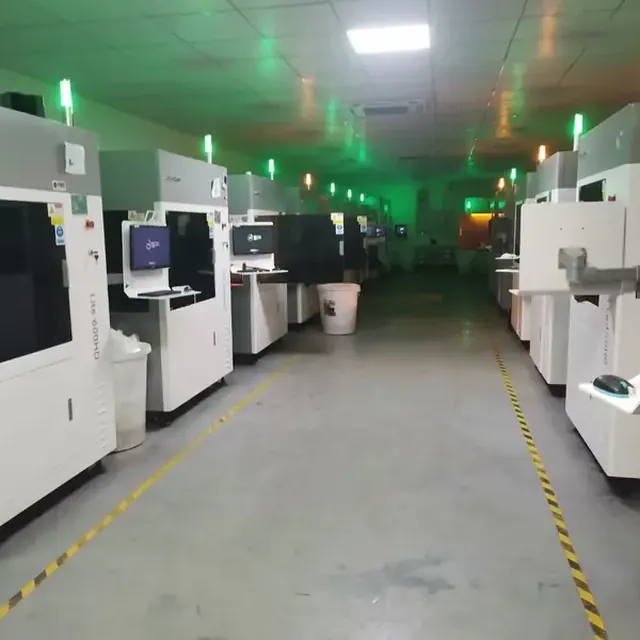
Large-scale CNC machining is subtractive manufacturing. Its core challenges are large workpiece size, heavy weight, and high cutting forces — while still holding strict dimensional accuracy and surface quality. That demands machines with greater rigidity, longer travel, higher-torque spindles, and specialized clamping and temperature-control solutions.
Typical envelope: length over 1 m and weight over 1 ton, beyond standard shop capacity.
| Machine type | Typical travel / specs | Key capabilities | Typical uses |
|---|---|---|---|
| Gantry mill | 6.2 m × 4.1 m × 2.6 m; table up to ~20 m² | Large milling, heavy structural machining | Aircraft wing spars, hull structures, large molds |
| Horizontal machining center (HMC) | 5.2 m × 3.1 m × 2.1 m | High-torque drilling, boring, multi-face work | Gearbox housings, turbine housings |
| Vertical machining center (VMC) | 3.2 m × 2.1 m × 1.6 m | Precision milling and surface finishing | Large plates, base frames |
| Large CNC lathe | Max Ø 1.6 m; length up to 4.2 m | Turning, facing, threading | Large shafts, rollers, pipe flanges |
| Universal turn-mill (e.g. Weingartner-class) | Turning length to 17 m; swing Ø to 2.8 m; weight to 60 t | Turn, mill, drill, hone in one setup | Gas-turbine shafts, large crankshafts, extruder screws |
| Comparison | Standard CNC | Large-part CNC |
|---|---|---|
| Travel / size | Usually ≤ 2 m; parts < 1 ton | Travel often > 3–5 m; parts > 1 ton |
| Machine type | VMC / HMC, standard lathes | Gantry mills, horizontal boring mills, heavy 5-axis |
| Material handling | Manual or standard forklift | Gantry crane, modular transporters |
| Spindle traits | Standard torque | High torque, reinforced spindle systems |
| Cutting tools | Standard end mills and drills | Extra-long tools, indexable inserts, dedicated roughers |
| Inspection | Benchtop CMM, vision systems | Floor CMM, laser tracker, large 3D scanning |
| Cost structure | Lower fixture and tooling cost | Higher tooling/equipment investment; unit cost on single large pieces can still be competitive |
Combine multi-part assemblies into one monolithic machined part — fewer assembly steps and less stack-up / human error.
Monolithic machining removes weld and bolt weak points, improving fatigue life and load capacity.
Less time spent machining many separate parts and assembling them afterward.
Despite huge size, tolerances around ±0.025 mm are achievable; some shops hold about ±0.18 mm on 10 m-class parts.
| Material category | Common grades | Typical applications |
|---|---|---|
| Aluminum alloys | 6061-T6, 7075-T6 | Aerospace structures, transportation parts |
| Carbon / alloy steel | 4140, 4340, A36 | Mining machinery, oilfield equipment |
| Stainless steel | 304, 316, 17-4PH | Marine engineering, chemical equipment |
| Titanium alloys | Ti-6Al-4V | Aerospace, defense |
| Nickel alloys | Inconel 718, 625 | Gas turbines, high-temperature service |
| Cast iron | HT250, QT500 | Machine bases, large equipment foundations |
| Engineering plastics | PEEK, PC, UHMW | Insulating structures, wear liners |
Larger parts magnify thermal expansion. Use high-pressure coolant, spindle thermal compensation, and temperature-controlled shops.
Long overhangs and thin walls chatter easily. Plan rough → semi-finish → finish steps and use on-machine inspection between ops.
Large parts often need flips for other faces. Laser alignment and locating pins keep repositioning consistent.
Finished parts may exceed standard freight size — specialized packaging, routing, and transport permits may be required.
| Industry | Typical Parts |
|---|---|
| Aerospace | Wing spars, fuselage frames, landing-gear components, engine mounts |
| Energy (wind / thermal / nuclear) | Wind-turbine hubs, gas-turbine shafts, generator rotors, steam-turbine casings |
| Oil & gas | Valve bodies, flanges, subsea equipment, fracking-pump components |
| Shipbuilding | Rudder blades, propeller shafts, hull beams, engine bases |
| Mining / construction machinery | Excavator booms, crusher frames, gearbox housings |
| Automotive | Engine blocks, chassis frames, large molds, battery-pack housings |
| Rail transit | Bogie frames, car-body structural components |
Deep cavities increase cycle time and tool deflection risk — simplify geometry where possible.
About ±0.1 mm/m is relatively achievable on gantry mills; tight ±0.01–0.05 mm should stay in local zones under ~100 mm.
6061-T6 aluminum machines efficiently; 7075-T6 is stronger but needs lower feeds.
Collaborate with the shop early to avoid late rework on oversized parts.
We use cookies to personalize your experience. By using this site, you agree to our Privacy Policy
Accept