
3D Printing
Stereolithography (SLA)
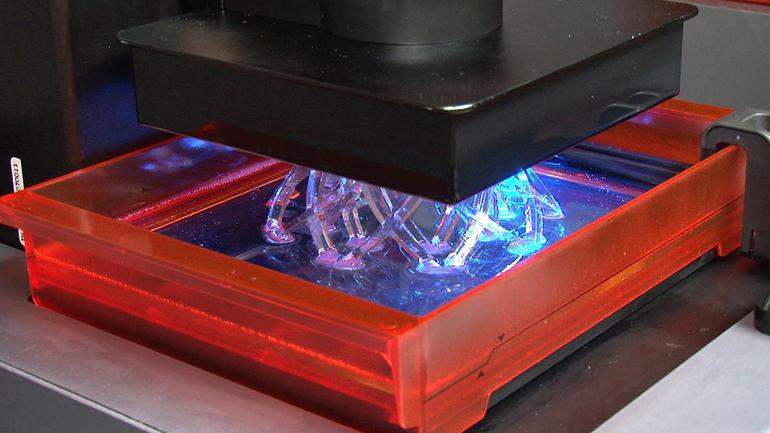
Stereolithography (SLA) cures liquid photopolymer with a precision UV laser, building parts layer by layer.
Create a quote
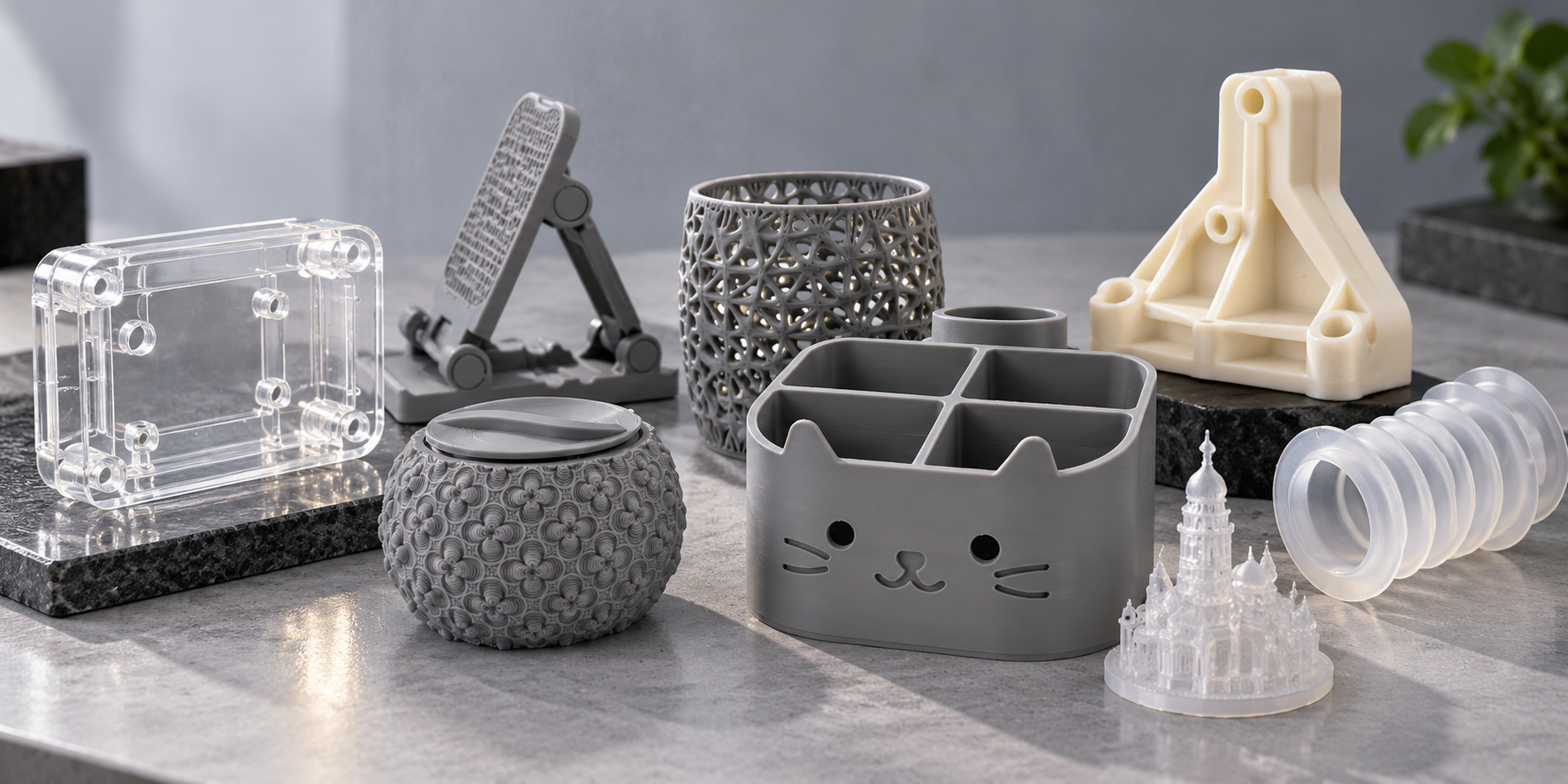
SLA 3D printing is known for fine detail and smooth surfaces, but the resin determines how a part behaves once it leaves the printer. A display model may need crisp lettering and a paintable finish. A working enclosure must also survive assembly, while a heated fixture needs to retain its shape under load. Producing all three with the same resin can leave the appearance satisfactory and the performance unsuitable.
No single SLA resin is the right choice for every application. Each formulation offers a different balance of surface quality, toughness, stiffness, and heat resistance. Start by asking what matters most for your part: fine visual detail, durability during use, or stability under heat. Defining that priority helps narrow the options, avoid paying for properties the project does not need, and reduce material-related rework. Then compare tensile strength, elongation at break, impact resistance, and heat deflection temperature against the demands of the application.
This guide connects those properties to the selection itself: which resin families to consider, how material behavior affects print quality, how to balance appearance with function, and how to compare specific grades before ordering. The goal is to arrive at a material choice that supports the job your part must do.
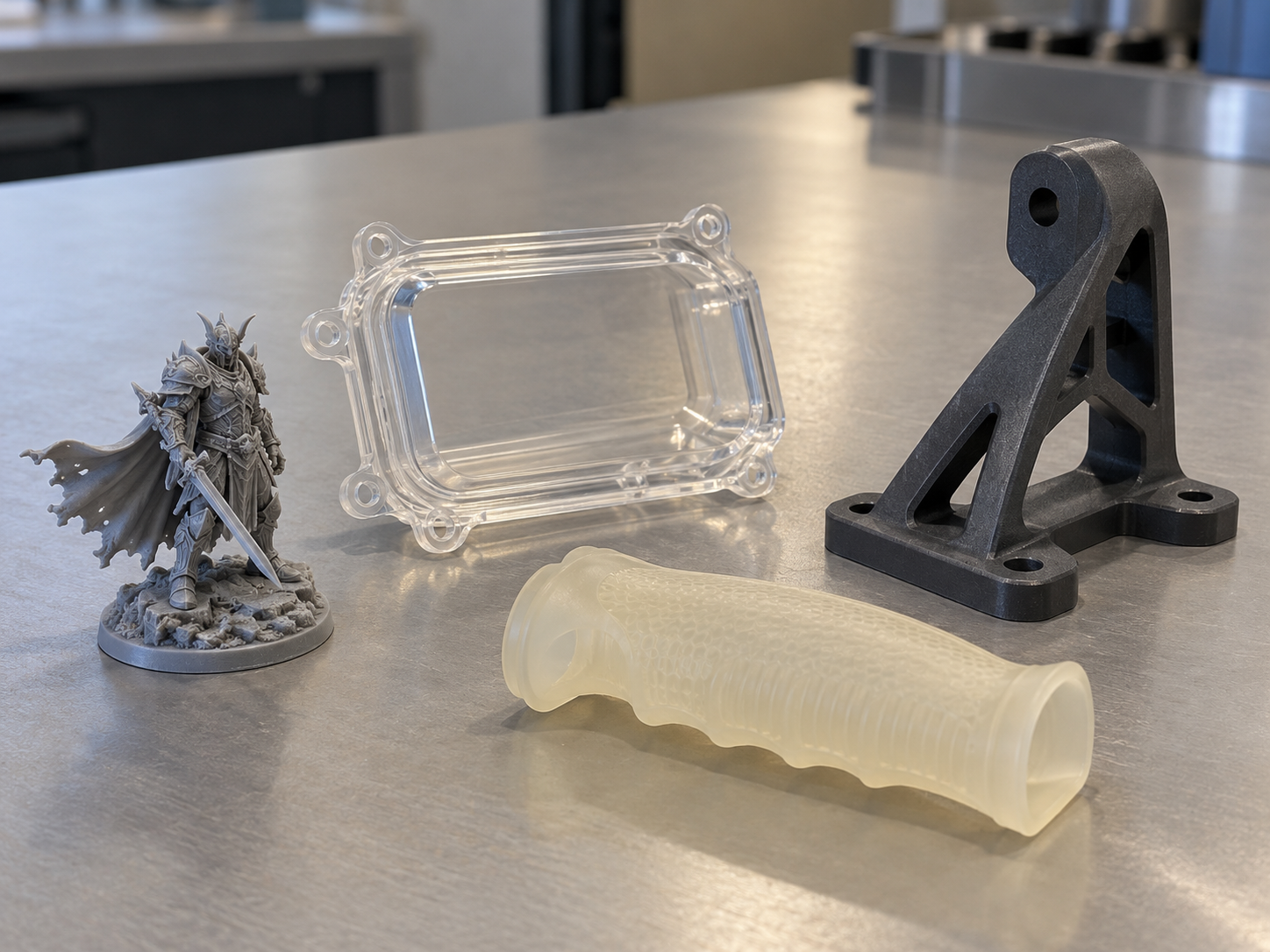
SLA resin, also called stereolithography resin, is a liquid photopolymer that solidifies through controlled light exposure. Its formulation influences both how it prints and the properties of the cured part. For selection, it helps to distinguish general-purpose materials for visual and geometric evaluation, engineering materials for mechanical or thermal demands, and specialized materials for a particular downstream or contact requirement.
These groups overlap. A clear material can support functional testing, and an engineering resin can reproduce fine detail. Begin with the requirement that determines whether the part succeeds, then evaluate the remaining requirements within that shortlist.
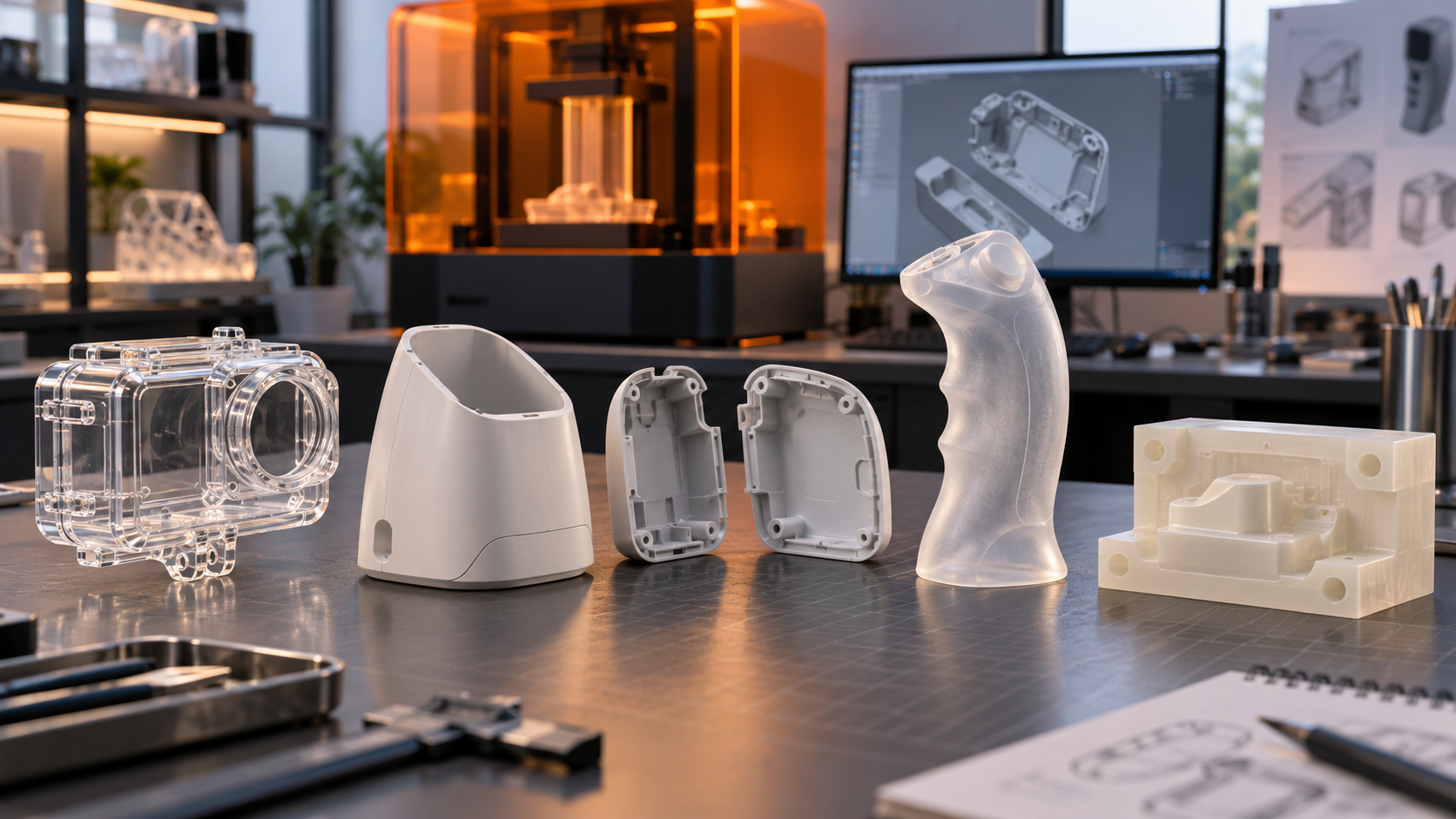
Standard or detail-focused resins are a practical starting point for concept models, miniature components, textured surfaces, and presentation prototypes. The selection should reflect the features that need to remain visible: engraved text, sharp transitions, thin decorative sections, or small openings.
For a painted enclosure model, prioritize the surface that will be reviewed and the finish it will receive. For a miniature, pay closer attention to small protrusions and recesses that must survive cleaning and support removal. A material that reproduces a feature accurately still needs enough handling resistance for that feature to reach the customer intact.
If transparency is part of the design, consider a clear grade. Specify what must be seen through the finished part and which surfaces are accessible for finishing. A transparent cover used to reveal a mechanism has a different requirement from an optical component with a defined transmission or distortion limit.
There is no universal layer height or resin color that guarantees the best detail for every system. Compare the important features using the proposed material, print settings, and finish. Our clear versus translucent resin guide explains how the required visual result changes the material and finishing choice.
Functional parts need more than a high tensile-strength value. A bracket must resist load, a clip must deform during assembly, and a locating fixture must limit movement. Each application puts a different property first.
Tough resins are useful candidates for housings and mechanical prototypes that need resistance to handling damage while maintaining useful rigidity. More compliant durable formulations may suit clips and components that need to bend. Because suppliers use these names differently, compare the exact grades' modulus, elongation, and impact data before deciding.
Rigid or reinforced resins are worth considering when deflection is the main concern. They can help a fixture hold position, but a high modulus does not establish resistance to impact or repeated bending. Heat-resistant grades address another requirement: retaining acceptable behavior during a specified thermal exposure. Evaluate temperature together with load and exposure duration.
Flexible or rubber-like resins belong in the shortlist when the component itself should compress or feel soft, such as a grip prototype. They are not automatically the best choice for a rigid housing that happens to contain one flexible latch. In that case, a tough material combined with suitable latch geometry may better represent the intended product.
Castable resins are selected for their role as sacrificial patterns, including compatibility with the foundry's burnout process. A detailed display resin is not automatically a suitable casting resin, and a reusable molding master has different requirements from a pattern that will be removed during casting.
Dental and biocompatible materials also require application-specific selection. A resin used to print a dental model is not necessarily suitable for direct contact use. Where contact requirements apply, the documented material and validated processing workflow must match that use. Treat these as separate selection conditions rather than assuming that a broad category name establishes suitability.
For terminology across these families, see SLA resin types and what they mean in stereolithography.
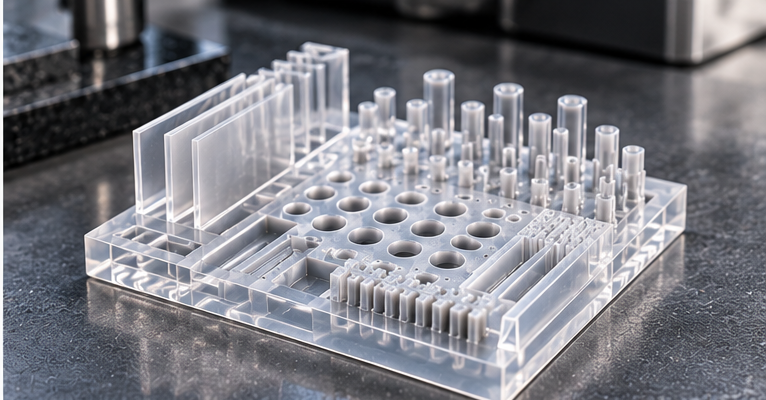
After identifying a suitable material family, consider how it behaves during printing. Fine detail comes from the interaction between the resin, exposure, geometry, and machine settings. Mechanical performance and surface quality cannot be ranked reliably from viscosity or a material label alone.
Viscosity describes resistance to flow. It affects how resin replenishes the build area and drains from features, while temperature changes can alter both flow and reactivity. A material that is more viscous may need different process settings; this does not automatically mean that it produces poorer detail.
For small cavities and closely spaced features, the practical concern is whether the workflow consistently forms and cleans those features. The supplier should use settings suited to the formulation and equipment. Formlabs' print-settings documentation shows how resin temperature and material-specific settings influence print quality and dimensional accuracy.
Resins differ in their response to light. Exposure must form the intended geometry without excessive curing beyond its boundary. Too little exposure can leave incomplete features; too much can enlarge or round them and reduce small openings.
Pigments, fillers, and other formulation components affect light behavior, but color alone is not a specification for accuracy. A dark resin is not inherently more accurate than every clear resin. The relevant evidence is the result achieved with the material's validated settings.
Dimensions can change as resin cures and during subsequent processing. Orientation and support placement also influence which surfaces need cleanup and how delicate features are held during the build. A thin cosmetic panel and a thick housing can therefore respond differently even when printed in the same grade.
Identify critical mating faces and visible surfaces before printing. For this material decision, the useful question is whether the proposed workflow delivers those features in the required finished condition. Detailed orientation and finishing instructions can then be addressed for the particular part rather than treated as universal resin rules.
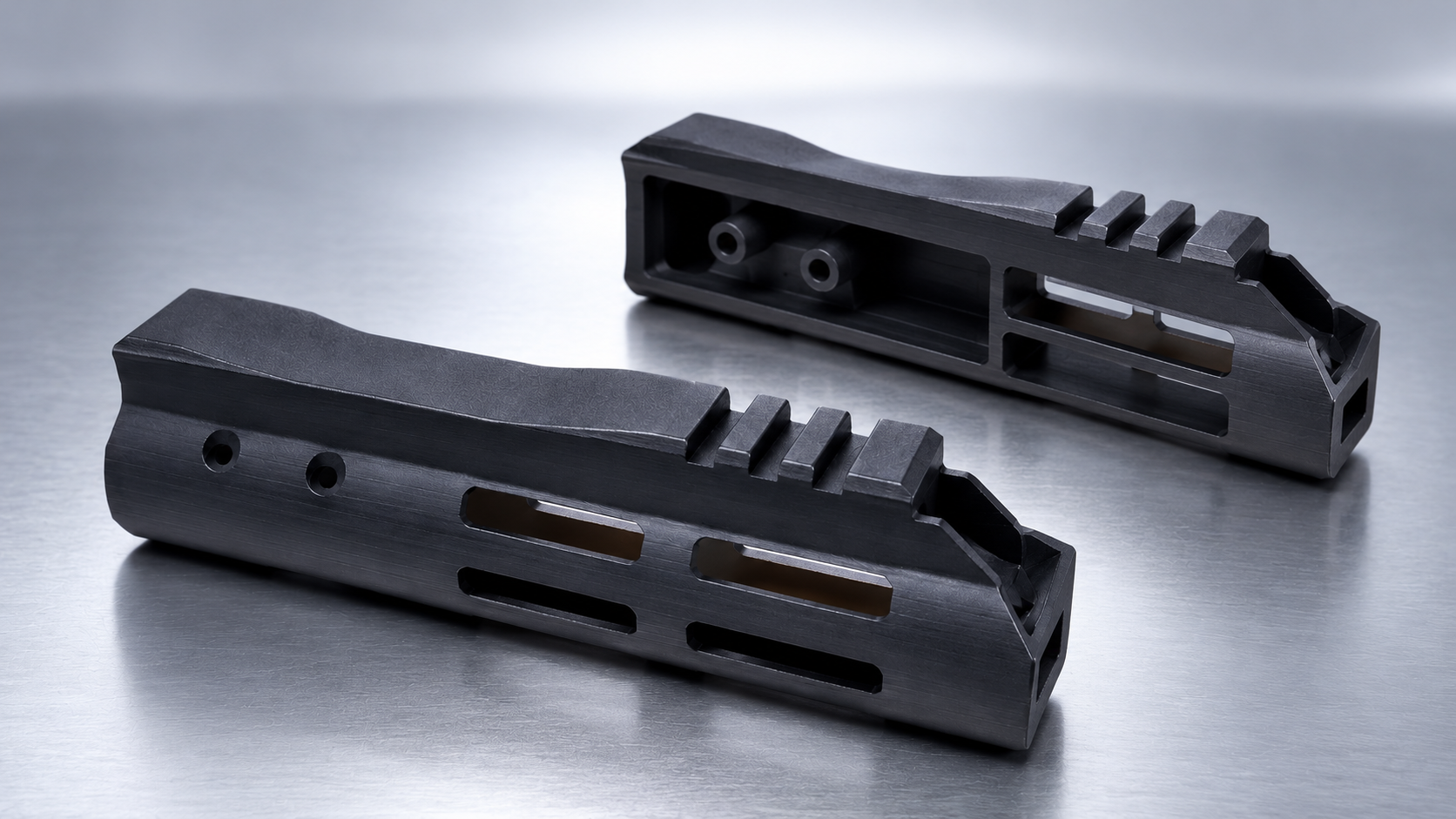
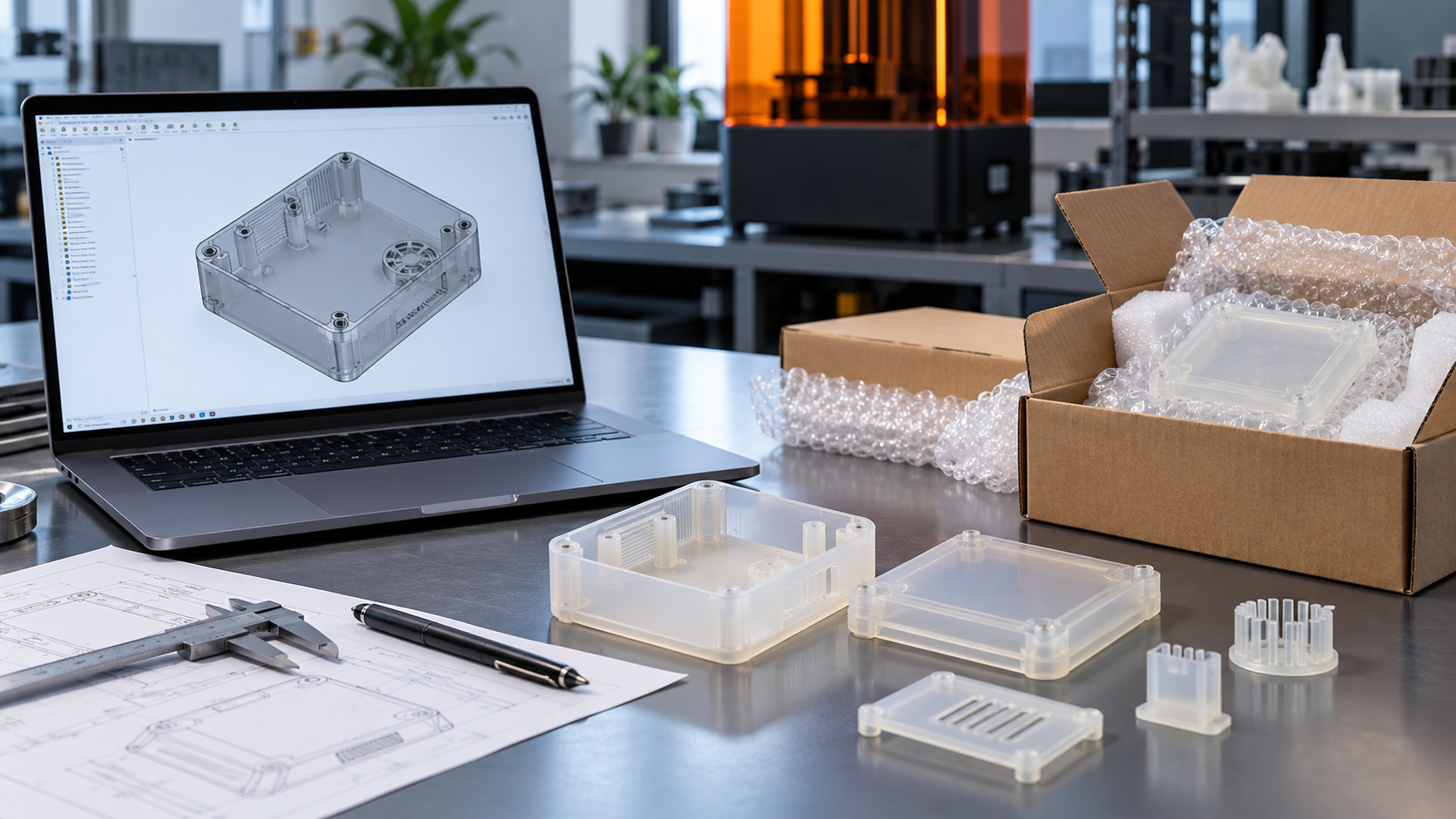
Many product prototypes combine a cosmetic surface with functional features. An enclosure may need a clean exterior, readable lettering, screw bosses, and a cover that opens repeatedly. The choice should account for all of them without assuming that appearance and strength are mutually exclusive.
First, identify the requirements that cannot be traded away. If a latch must survive repeated assembly, reject materials that cannot support that behavior. Within the remaining candidates, compare the visible finish and the reproduction of the smallest important features. This gives the material selection a clear order without removing appearance from the decision.
A useful first approach is one balanced engineering resin for the complete part. If it meets the mechanical requirement but needs cosmetic improvement, evaluate sanding, primer, paint, or coating on the appropriate surfaces. Those operations may improve appearance, but they should not alter a critical fit or erase small markings.
If one material cannot meet the requirements together, consider separate cosmetic and structural components. For example, an opaque working enclosure could use a clear inspection window instead of making the entire assembly transparent. Account for the resulting joints, adhesive compatibility, and assembly tolerances. Separate parts are helpful only when the assembled result still represents the intended design.
For development work, separate prototypes may be simpler. A presentation model can establish appearance while an unpainted assembly evaluates movement and retention. Their results answer different questions; neither should be used to claim that the other requirement has already been validated.
When comparing SLA printing materials, family names explain the selection direction, while numerical data helps distinguish actual products. The following comparison uses three published SLA resin grades to show different balances of properties.
All solid-property values below come from the UV-postcure columns of the cited data sheets. The liquid-viscosity row is measured before curing at 30°C. Using one stated cure category makes the comparison clearer, although individual test revisions and preparation conditions still need to be checked for a final engineering decision.
Property | WaterShed XC 11122 | Somos Taurus | Somos PerFORM |
Liquid viscosity at 30°C | Approximately 260 mPa·s | Approximately 350 mPa·s | Approximately 1,000 mPa·s |
Reported tensile strength | 50.4 MPa at break | 46.9 MPa at yield | 68 MPa; endpoint not specified |
Tensile modulus | 2,770 MPa | 2,310 MPa | 10,500 MPa |
Elongation at break | 15.5% | 24% | 1.1% |
Notched Izod impact | 25 J/m | 47.5 J/m | 17 J/m |
HDT at 0.46 MPa | 50°C | 62°C | 132°C |
HDT at 1.81 MPa | 49°C | 50°C | 82°C |
Solid-property condition | UV postcure | UV postcure | UV postcure |
Sources: WaterShed XC 11122, Somos Taurus, and Somos PerFORM, revision 0123a. Tensile properties use ASTM D638M or D638-14; notched impact uses D256A or D256A-10e1; HDT uses D648 or D648-16. The original sheets identify the method for each entry. One mPa·s equals one cP.
Read the tensile-strength row carefully: yield and break are different endpoints, so these figures should not be treated as a direct strength ranking. Compare elongation at break with elongation at break, and thermal values measured at the same load. Missing or differently defined data should be resolved before making a specification.
The table's purpose is to reveal the trade-offs. A grade can combine high stiffness with low elongation, while another can offer more deformation before break and a higher notched-impact result. There is no reason to expect one material to lead every column.
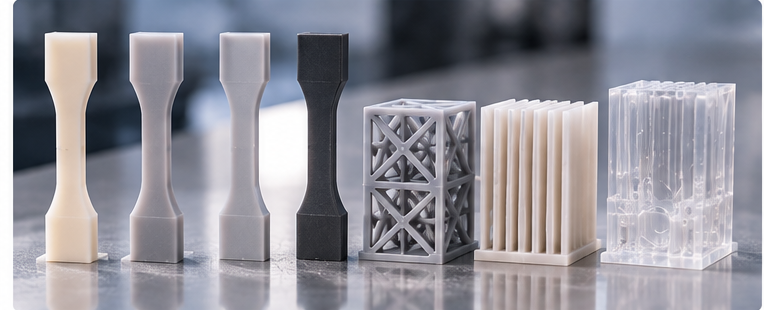
The numbers become useful when connected to the way the component will be loaded, handled, or inspected. They help explain why two visually similar SLA parts can behave differently.
Tensile strength describes stress at a stated point in a tensile test; it is not the total force that any finished part can carry. Load capacity also depends on the cross-section, geometry, and loading direction. Tensile modulus describes stiffness in the elastic range.
For the same geometry under a small elastic load, a higher modulus generally means less deflection. This matters for a locating fixture even if both candidate materials are strong enough to avoid immediate fracture. A bending clip, however, needs an acceptable combination of stiffness, strain capacity, and assembly force. Maximizing stiffness can work against its purpose.
Elongation at break describes strain when a test specimen fractures. It helps distinguish a material that accommodates more deformation from one with limited strain capacity. It does not tell you whether a clip returns to its original shape or how many cycles it will survive.
Impact data addresses sudden loading under a defined test. Use it to screen materials for handling demands, then evaluate the real part where a boss, sharp corner, or thin section could control failure. A favorable test value supports the choice; it does not replace the component test.
HDT is the temperature at which a test specimen reaches a specified deflection under a specified flexural stress. It is neither the melting point nor the universal temperature at which every feature starts to deform.
The comparison table shows why the test load must remain visible: a material's result at 0.46 MPa can differ substantially from its result at 1.81 MPa. A heated locating fixture needs both thermal evidence and a check of its allowable movement under the actual load and exposure duration.
Viscosity helps determine processing requirements. It does not directly predict the strength of the cured part. Likewise, a fine layer setting does not establish a dimensional tolerance or prove that a snap fit will survive use.
For selection, connect each parameter to its purpose: flow and exposure support repeatable manufacturing; mechanical and thermal properties support the intended function; inspection confirms the important dimensions. This avoids choosing a material because it performs well on a metric unrelated to the task.
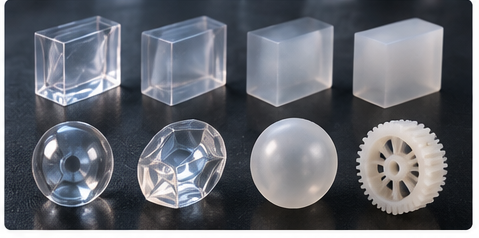
The resin selection is incomplete until the delivered condition is defined. A printed part, a postcured part, and a coated part may have different dimensions, surface appearance, and mechanical behavior.
Cleaning removes uncured resin from surfaces and cavities. The cleaning medium, exposure time, access to internal features, and drying step should follow the material's processing guidance. Remaining resin can obscure small details, while an unsuitable cleaning route can affect the part itself.
For a hollow or intricate component, confirm that the relevant surfaces can actually be reached and cleaned. This is a geometry and workflow issue as well as a material issue; selecting a detail-focused resin cannot compensate for an inaccessible trapped-resin region.
Post-curing changes the polymer network and can alter stiffness, elongation, thermal behavior, and dimensions. The appropriate cycle depends on the formulation. Formlabs' post-curing guide explains why properties are tied to a stated material-specific cure condition.
More processing does not necessarily improve every property. For example, the cited Somos Taurus sheet reports these results under two conditions:
Property | UV postcure | Thermal postcure |
HDT at 0.46 MPa | 62°C | 91°C |
Elongation at break | 24% | 17% |
Notched Izod impact | 47.5 J/m | 35.8 J/m |
The thermal condition raises the reported HDT while reducing the reported elongation and impact values. For a heated fixture, that trade-off may be useful; for an assembly feature, it may change the decision. These values describe this grade and the cited conditions, not a universal curing rule.
Sanding, polishing, coating, and painting can help achieve a presentation finish, but they may remove material or add thickness. Keep cosmetic treatment separate from dimensional requirements on mating faces, small holes, and latch surfaces.
For a clear part, evaluate transparency after the agreed finish. For a painted functional housing, inspect fit after painting if the coating reaches an interface. AIHFabs' finishing options provide a starting point for discussing the delivered surface condition with the material choice.
The required material can change as the project moves from appearance review to assembly testing and then to production evaluation. An early concept model may mainly communicate size and shape. A later prototype may need to retain a fastener, protect electronics, or operate near a heat source.
Use each stage to define what the part must prove. This keeps a successful visual model from being mistaken for evidence of mechanical durability, and it avoids specifying a costly or specialized material before its properties are needed. Application-specific testing can then be developed around the actual component.
Use the following table to translate the discussion into a project brief. The material family is a starting point; the final column identifies what should establish whether the choice is suitable.
Part or use | Resin family to consider | Selection priority | Acceptance check |
Painted display enclosure | Standard or detail-focused | Detail, finish, handling | Review the finished cosmetic faces |
Transparent inspection cover | Clear | Visibility and required mechanics | Inspect through the actual wall geometry |
Removable cover with clips | Tough or durable | Deformation, retention, damage resistance | Test the specified assembly sequence |
Locating or checking fixture | Rigid or reinforced | Deflection and dimensional stability | Measure under the intended working load |
Component used near a heat source | Heat-resistant engineering resin | Temperature, load, exposure duration | Test function and dimensions after exposure |
Soft grip prototype | Flexible or rubber-like | Hardness, compression, recovery | Evaluate feel and repeat deformation |
Sacrificial casting pattern | Castable | Downstream process compatibility | Approve the pattern and burnout workflow |
Dental or contact-related part | Application-specific documented grade | Intended use and validated processing | Meet the applicable acceptance requirements |
For an illustrative electronic enclosure, a standard resin may be sufficient for a painted concept review. Once repeated opening becomes part of the test, the latch performance controls selection and a tough or durable grade enters the shortlist. If the assembly later operates near a heat source, reassess the thermal requirement rather than carrying the earlier material choice forward automatically.
A wider range of resin properties gives SLA more roles within product development: detailed models can lead to functional assemblies, inspection aids, and selected end-use components. The opportunity comes from matching the material to each role and validating the finished result.
For production, extend the review beyond whether one prototype works. Consider sustained loading, the intended environment, repeated operation, and consistency between supplied parts. Establish the approved grade, processing route, finish, and acceptance criteria before increasing quantity.
SLA is most useful when its detail and geometry capabilities work together with an appropriate material specification. If the application depends on the exact long-term behavior of ABS, polypropylene, or another thermoplastic, an ABS-like or PP-like label is not enough to establish equivalence; compare the relevant evidence and manufacturing options.
Need help choosing the right SLA material? Contact the AIHFabs team with your CAD model, quantity, intended use, and important appearance or performance requirements. Include any operating temperature, load, repeated movement, or critical dimensions that will influence the recommendation.
You can explore our SLA 3D printing service, review the available material options, or upload your model for a quotation. We can discuss the material and finishing requirements together so the proposed process reflects what your part needs to achieve.
1. Stratasys Direct. How to Choose the Best SLA 3D Printing Resin for Your Application.
2. Protolabs Network. What's the Right Resin for SLA? 3D Printing Materials Compared.
3. JLC3DP. Which Resin Is Best for 3D Printing Fine Details vs Functional Parts?
4. Stratasys. Somos WaterShed XC 11122 Data Sheet, 0123a.
5. Stratasys. Somos Taurus Data Sheet, 0123a.
6. Stratasys. Somos PerFORM Data Sheet, 0123a.
7. Formlabs. Using the PreForm Print Settings Editor.
8. Formlabs. How Formlabs Develops and Validates Print Settings.
9. Formlabs. How to Post-Cure Your Resin 3D Prints.

A process that fits this note. Open the spec, or put the file on a quote.
Stereolithography (SLA) cures liquid photopolymer with a precision UV laser, building parts layer by layer.
Create a quote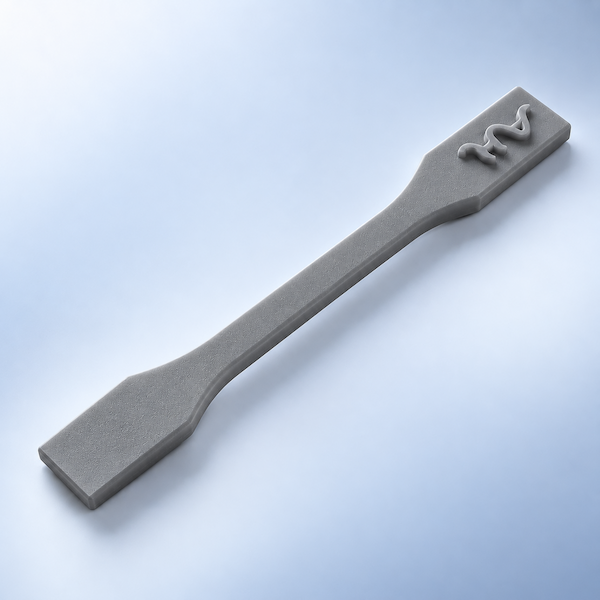
Digital Light Processing (DLP) solidifies an entire layer of photopolymer at once using a projected image.
Create a quoteMaterials that sit next to this article. Check the card, then upload CAD.
Process, finish, and file notes from the shop — not a marketing blog.
Company, payment, shipping, and process answers by topic.
Questions about 3D printing processes, materials, MOQ, samples, and custom projects.
AIHFABS quotes custom 3D printing and CNC machining from a CAD upload. Compare SLA, SLS, MJF, SLM, FDM, DLP, milling, and turning, then add finishing such as vapor smoothing, dyeing, anodizing, polishing, or powder coating in the same order.
Instant quoting is built for prototypes, jigs, housings, and small-batch production. You see material, process, quantity, and lead time together, which keeps engineering changes from turning into a new round of supplier emails.
You can review material, process, quantity, and lead time together, so engineering changes do not turn into another round of supplier emails.
Upload STL, STEP, and other common CAD formats for an online quote.
Compare 3D printing technologies and CNC options on the same part.
Select polymers or metals, then add 3D Plus hardware finishing when needed.
Review price and lead time before checkout, or request a manual quote for special specs.
If this page describes a process, industry, or sample part you want to reproduce, start from the upload flow and match technology plus finishing to your drawing.
We use cookies to personalize your experience. By using this site, you agree to our Privacy Policy
Accept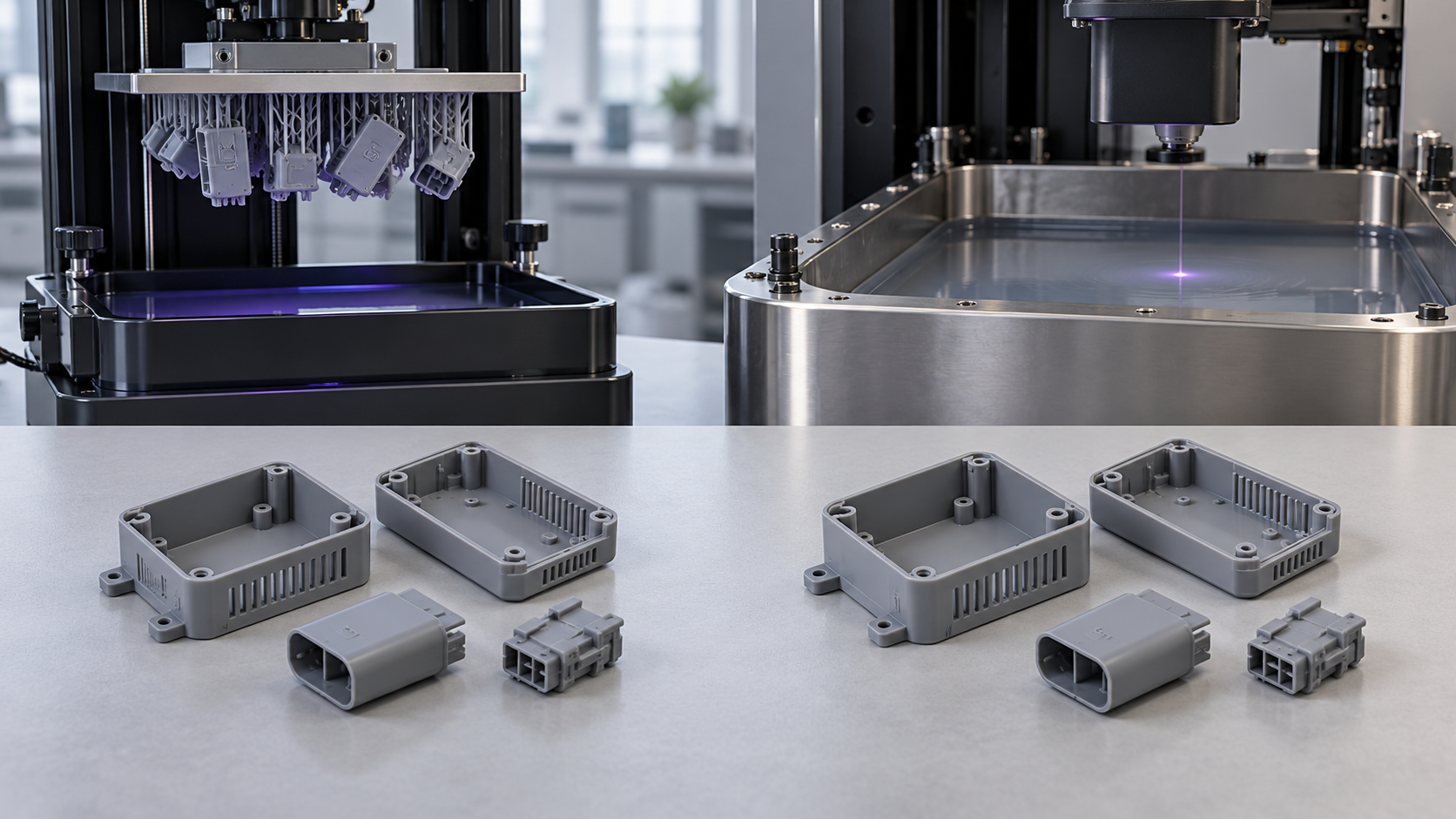

Leave A Comment