The resin 3D printing market has matured considerably, but one question persists across forums, trade shows, and procurement meetings: SLA or DLP — which technology delivers better results for your specific application?
The answer is not as simple as comparing spec sheets. Both Stereolithography (SLA) and Digital Light Processing (DLP) use photopolymer resins and UV light to build parts layer by layer, but their fundamentally different approaches to light delivery create distinct performance profiles. This deep-dive comparison will help you determine which technology aligns with your production goals.
How They Work: The Fundamental Difference
SLA — The Laser Approach
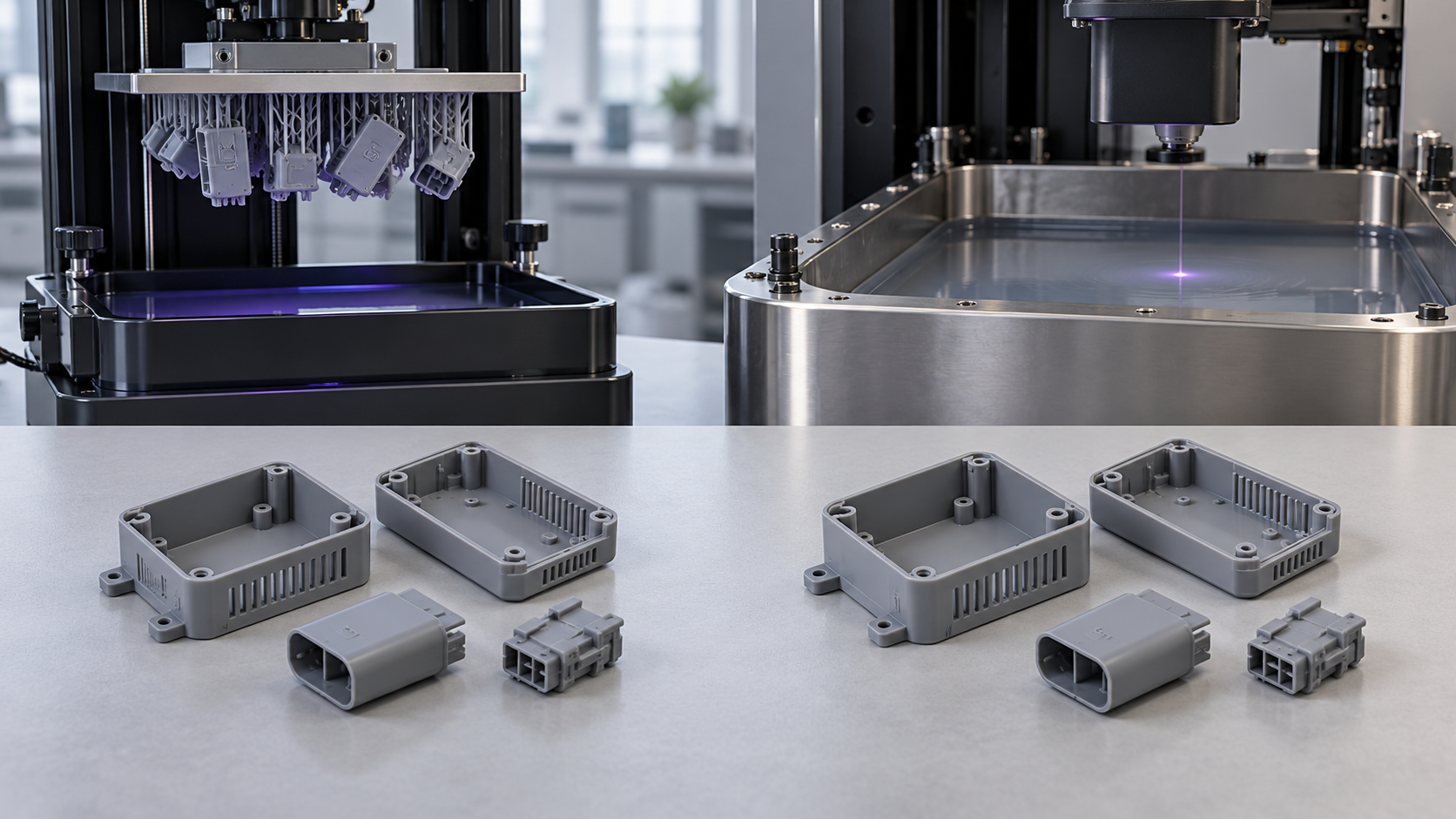
SLA uses a focused ultraviolet laser beam directed by a galvanometer (galvo) scanning system. The laser traces the cross-sectional profile of each layer point-by-point, line-by-line, curing the resin along its path. Think of it as an extremely precise pen drawing each layer's outline.
Key characteristics:
Laser spot size varies by system and should not be treated as a finished-part dimensional tolerance
Point-by-point scanning means cure time scales with layer complexity
No pixel grid — edges are defined by continuous laser paths
Mature technology with decades of industrial refinement
DLP — The Projector Approach
DLP employs a digital projector — typically based on Texas Instruments' DMD (Digital Micromirror Device) chip — to project an entire layer's cross-sectional image onto the resin surface simultaneously. Millions of microscopic mirrors on the DMD chip tilt individually to control which pixels receive UV light.
Key characteristics:
Entire layer cured in a single exposure event
Resolution is tied to the projector's native pixel count
Pixel grid defines edge geometry (though pixels are often sub-visual)
Speed advantage grows with layer complexity — Multiple parts can share the same layer exposure, although total build time also depends on layer count, material settings and machine movements
How Whole-Layer Exposure and Laser Scanning Differ
DLP uses a digital micromirror device to project a complete layer image onto the resin surface. Thousands of tiny mirrors switch on and off, so the entire cross-section of every part on that layer cures at the same time. SLA uses a laser that scans point by point along the part outline and fills the interior. That difference is mechanical: DLP exposure is a whole-layer event, while SLA exposure is a moving path. The way light is delivered shapes what the process can do with small features. DLP detail comes from the projected pixel grid; SLA detail comes from the laser spot size and the path the scanner follows.
In a design review, the useful question is not which acronym is better, but how the exposure method interacts with feature size, orientation, and support placement. Surface finish also follows from exposure method. A projected layer tends to expose the whole cross-section uniformly, which supports consistent detail across many small features in the same layer. A scanned laser can produce smooth surfaces too, but the result depends on scan strategy, spot overlap, and how the path handles tight corners. For small detailed prototypes, this means the same CAD model can behave differently depending on wall thickness, feature spacing, and the direction a surface faces.
A typical tolerance of about ±0.2 mm applies to well-supported geometry, and exact surface results depend on orientation, supports, resin, and post-processing. Materials for DLP include Standard, High-Detail, Tough, Ultra Tough, High-Temp, Premium Clear, Castable, and Biocompatible by project qualification. Default post-processing is an IPA wash, UV post-cure, and support removal. Those steps matter because a sharp edge, tiny hole, or thin fin can be affected as much by support removal and cleaning as by the exposure method itself.
What Do SLA and DLP Have in Common?
SLA and DLP both use light to selectively cure liquid photopolymer resin, building a part layer by layer. In this article, SLA refers specifically to laser-based stereolithography.
Both processes require attention to orientation, support placement and the material’s cleaning and post-curing instructions. These shared requirements influence the final result: a supported surface may need finishing, a hollow part needs access for resin removal, and a functional prototype needs a suitable resin.
The practical comparison therefore extends beyond the light source. For either process, identify critical dimensions, visible surfaces and material requirements before deciding how the part should be manufactured.
What DLP and SLA Share as Vat Photopolymerization Processes
It is easy to forget that DLP and SLA belong to the same family. Both are vat photopolymerization processes, and both use light to cure liquid photopolymer resin into solid layers. The shared foundation explains why many design rules, material questions, and post-processing steps feel similar even when the exposure method differs. A reader explaining the comparison to a colleague can start with that shared base, then separate the exposure method as the main technical fork.
1. Both cure photopolymer resin with light. A DLP projector or an SLA laser supplies the energy, but the chemical reaction is still photopolymerization: liquid resin crosslinks into a solid layer when exposed to the right wavelength and dose.
2. Both build parts layer by layer from a resin vat. The build platform rises or the resin level adjusts after each cured layer, so the final part is a stack of thin cross-sections rather than a molded or machined block.
3. Both need supports for overhangs and isolated features. Supports hold new layers in place during the build, and they are removed later, which means support marks and surface finish must be planned during orientation.
4. Both require post-processing before a part is ready to judge. A typical workflow is IPA washing, UV post-curing, and support removal, and the final surface depends on resin choice, orientation, supports, and finishing steps.
Head-to-Head Comparison
The following overview highlights the differences that matter when comparing SLA vs DLP 3D printing. Use the detailed sections below to evaluate them against your part requirements.
| Comparison | Laser-Based SLA | DLP | What to Check |
|---|
| Light delivery | A laser scans the layer geometry | A projector exposes a complete layer image | How the available system handles your geometry |
| Fine details | Influenced by laser optics, scanning control and resin | Influenced by projected pixel size, optics and resin | Small holes, edges, lettering and narrow gaps |
| Batch printing | Additional geometry can require additional scanning | Multiple parts can share a layer exposure | Parts per build and total production time |
| Build size | Large-format industrial systems are available | Usable area and pixel size depend on the projection system | Whether the part fits with its supports and orientation |
| Surface finish | Layer orientation and support contacts affect appearance | Layer orientation, pixel-related texture and support contacts affect appearance | The required finish on visible and mating surfaces |
| Materials | Select a resin qualified for the specific system | Select a resin qualified for the specific system | Properties in the specified finished condition |
| Cost | Includes material, machine time and finishing | Includes material, machine time and finishing | Comparable quotations for the same requirements |
Precision and Surface Quality
This is where the debate gets nuanced.
SLA achieves its precision through laser focus control. With no pixel grid, curved surfaces and organic shapes are rendered as smooth, continuous curves. The laser spot can be made extremely small, and the galvo system provides exceptional positional accuracy. SLA can produce smooth surfaces, while a mirror-like finish may require additional post-processing
DLP achieves precision through pixel density. Modern DLP systems with 4K and 8K projection engines deliver XY pixel sizes in the 25–50μm range. The surface may exhibit subtle pixel faceting on highly curved surfaces when examined under magnification, though this is often invisible to the naked eye. In practice, DLP surface roughness on figurine prints has been measured at approximately Rz=25μm — more than adequate for direct painting without additional sanding.
Verdict: Both processes can produce detailed parts. Compare critical dimensions and visible surfaces using the proposed material and finishing conditions.
Speed and Throughput
This is where DLP's architecture delivers a decisive advantage.
Because DLP cures an entire layer in one flash — regardless of how many parts are on the build plate — its throughput scales exceptionally well for batch production. A build plate full of 50 miniature bases cures at the same speed as a single small part.
SLA, by contrast, must physically trace every feature on every layer. A plate full of parts takes proportionally longer than a single part. Typical industrial SLA print speeds hover around 20mm/h in Z-height, while DLP systems can achieve 100–170mm/h depending on resin and layer thickness.
Verdict: DLP wins decisively on throughput, particularly for batch production runs and high-mix manufacturing environments.
Why Dense Small-Part Layouts Change the Comparison
Introduction: DLP and SLA both cure photopolymer resin in a vat, but they expose each layer in different ways that affect small-part detail, speed, and finish.
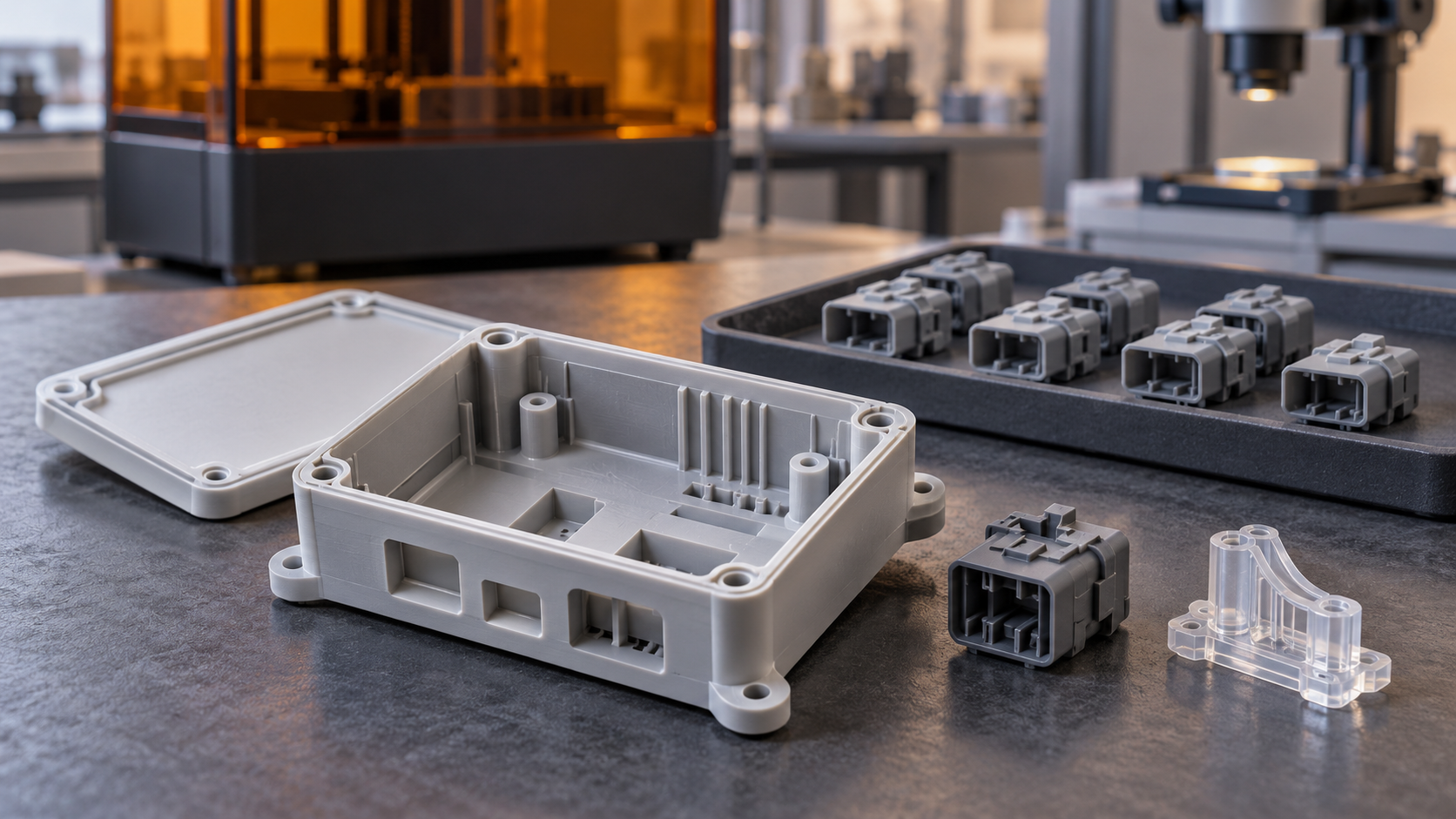
When a project needs small, detailed prototypes, DLP and SLA are often compared side by side. The parts may be nested tightly on one build plate: tiny housings, connectors, jewelry patterns, miniature features, or small brackets with fine text. At first glance the two processes look similar because both use liquid photopolymer resin and both build parts layer by layer. The practical difference shows up in how the light reaches the resin, how XY detail is formed, and how a dense batch behaves when many small parts share the same plate. A useful comparison follows that scenario rather than treating DLP and SLA as generic lists of pros and cons.
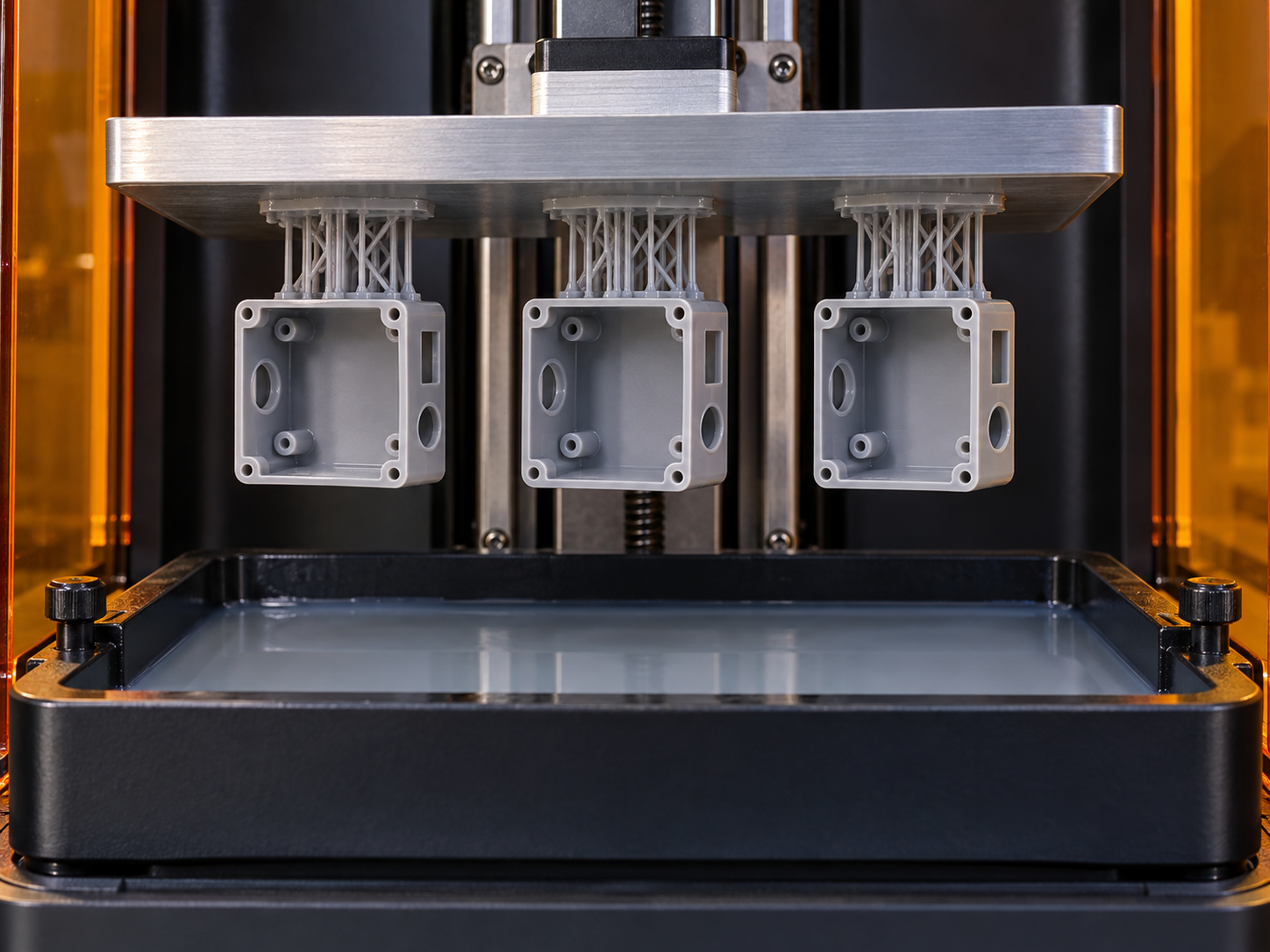
Dense small-part layout is where the comparison becomes practical. Imagine a plate filled with twenty small brackets, jewelry patterns, or miniature housings. With DLP, the projector exposes the entire layer in one image, so the exposure step covers all twenty parts at once. With SLA, the laser still has to trace each part's outline and fill areas. More parts mean more scan path, more travel, and more time on the same layer. That is why DLP can be efficient for small parts arranged in dense batches. The efficiency comes from whole-layer projection, not from a claim that DLP is always faster. A single large part with a simple cross-section may not produce the same dense-layout effect, and a batch with tall parts may be limited by layer count rather than by XY scan length. Uniformity is the other side of dense layouts. A single projected layer can expose many small parts under the same light pattern, which helps keep detail and surface behavior consistent across the batch. SLA can also produce consistent parts, but the scan sequence and local exposure history can vary across the plate. In practice, designers should still review orientation, support placement, and resin choice. Nesting small parts closely can reduce unused plate area and consolidate handling, yet it also makes support planning more important because each part needs stable overhangs and clean separation after the build. A typical tolerance of about ±0.2 mm applies to well-supported geometry, and exact surface results depend on orientation, supports, resin, and post-processing. The dense-layout advantage is mainly about exposure time and batch behavior, not a promise of identical results for every geometry. The strongest use case is a plate of many small, shallow, detailed parts that benefit from one shared exposure pattern.
Build Volume and Scalability
SLA systems are available in a wide range of build volumes — from desktop units to industrial machines capable of printing parts exceeding one meter in length. The laser scanning approach scales naturally to larger formats because the galvo mirrors can be paired with larger resin vats.
DLP build volume is constrained by the projection optics. The projected image area must cover the entire build surface at the required resolution. Larger build areas demand higher-resolution projectors or accept lower pixel density. Most DLP systems operate in the small-to-medium build volume range.
Verdict: SLA offers superior scalability for large-format applications. DLP excels in small-to-medium volumes where high resolution is paramount.
Material Compatibility
Both technologies use photopolymer resins, and there is significant overlap in material availability. However:
SLA systems from major manufacturers often operate with proprietary resin ecosystems, providing tightly validated material-process combinations but limiting third-party options.
DLP systems tend to be more open, supporting a broader range of third-party resins. Many DLP platforms offer open material programs, enabling users to qualify resins from multiple suppliers and reduce per-unit material costs by 40–60%.
Match Resin Properties to the Application
Material compatibility is only the starting point. To choose between SLA and DLP for a functional part, first identify the resin properties the application needs.
| Application | Resin Category to Evaluate | Key Selection Criteria | Main Trade-Off |
|---|
| Appearance model or form-check prototype | Standard resin | Surface quality, stiffness and dimensional stability | A resin suitable for appearance evaluation may not tolerate repeated impact or flexing |
| Clip, latch or snap-fit prototype | Tough resin | Elongation, impact behavior, stiffness and repeated-deflection performance | Increased flexibility may affect how firmly the part holds its shape |
| Heat-exposed fixture or housing | Heat-resistant resin | Heat-deflection data, test load and required curing conditions | Heat resistance alone does not establish impact resistance or long-term load capacity |
| Transparent cover or observation model | Clear resin | Required visibility, wall geometry and finishing access | Clear resin alone does not guarantee an optically clear finished surface |
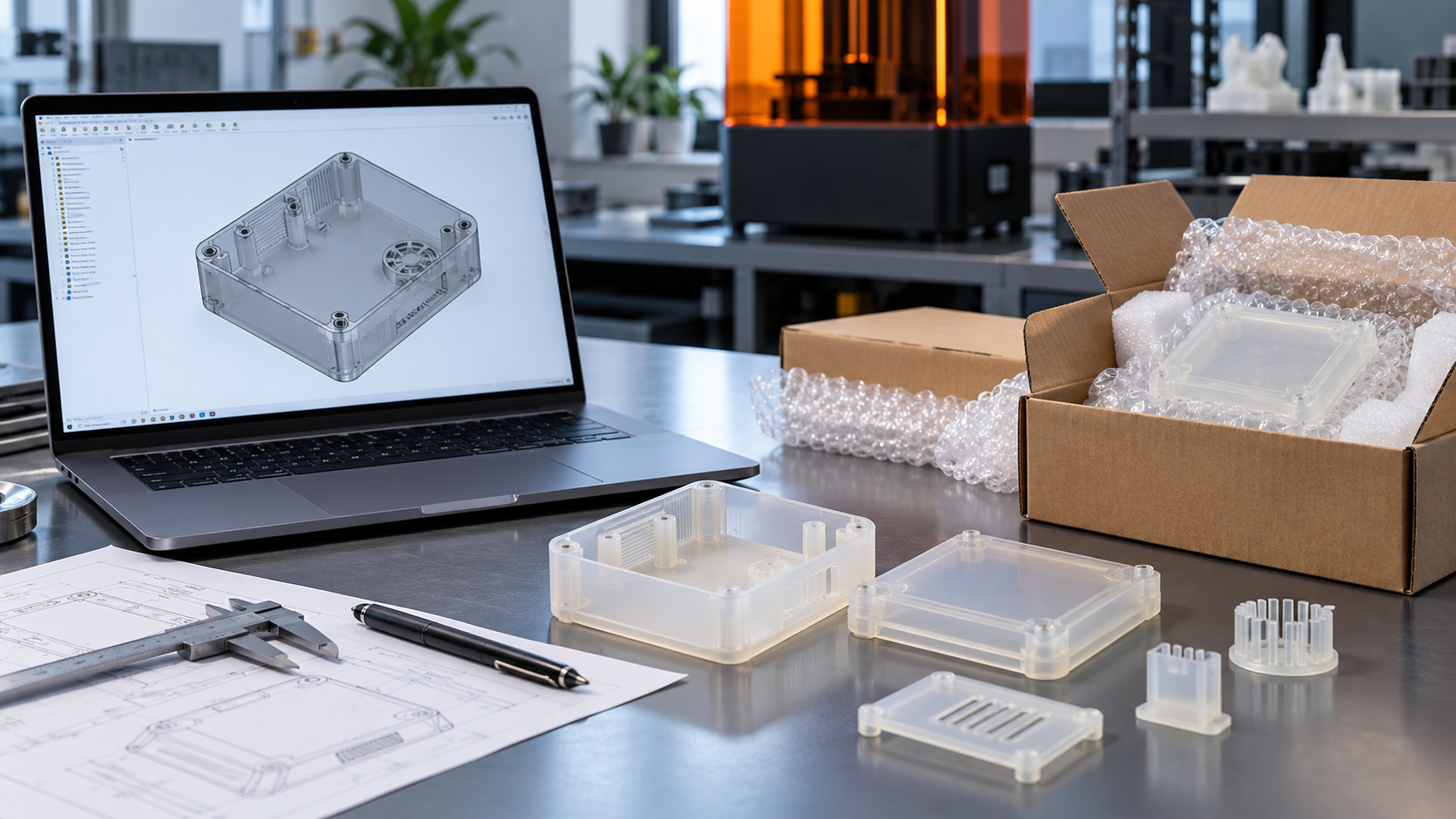
For example, a small snap-fit may fit efficiently into a DLP batch, but the available resin must first meet its deflection requirements. A transparent enclosure needs a suitable clear material and a practical finishing route, whichever printing process is selected.
Confirm the available material grade for the chosen system and review its technical data sheet. Compare properties measured under relevant conditions, including the specified post-cure.
Browse the AIHFabs materials catalogue or read our SLA resin selection guide for more detailed material considerations.
Verdict: DLP generally offers greater material flexibility. SLA provides tighter process control at the cost of vendor lock-in.
Cost Structure
The total cost of ownership differs significantly between the two technologies:
| Cost Factor | SLA | DLP |
|---|
| Entry-level machine cost | Higher (industrial-grade lasers) | Moderate to high |
| Light source lifespan | Laser diodes: long but replacement is costly | DMD chips: 20,000–50,000 hours |
| Material cost | Often proprietary, higher per-liter | More open ecosystem, competitive pricing |
| Maintenance complexity | Galvo calibration, laser alignment | Relatively low — solid-state projector |
| Consumables | Resin, cleaning solvents, FEP films | Resin, cleaning solvents |
Verdict: DLP typically offers a lower total cost of ownership, driven by open material ecosystems and longer-lasting light sources. SLA's higher upfront investment is justified when absolute surface quality and large-format capability are non-negotiable.
Post-Processing and Final Part Quality
A fair SLA vs DLP comparison should use parts in the same delivered condition. Printing is only one stage; cleaning, support removal, curing and finishing also affect appearance, fit and production time.
| Operation | What It Does | What to Confirm for Your Part |
|---|
| Cleaning and drying | Removes residual liquid resin and prepares the part for subsequent processing | Whether cavities and channels can be cleaned and drained using the specified procedure |
| Support removal | Removes structures used to stabilize the part during printing | Where contact marks are acceptable and how fragile features will be protected |
| Post-curing | Develops the material properties specified for the resin where required | The prescribed curing conditions and when critical dimensions will be inspected |
| Sanding, polishing or coating | Adjusts surface appearance and the final finish | Which surfaces need treatment and where material removal or coating thickness could affect fit |
Follow the material-specific processing sequence; support removal and curing order should not be assumed identical for every resin.
For an enclosure, keep support contacts away from visible faces and critical mating edges where practical. For a batch of small components, compare the handling and finishing work as well as printing speed.
Verdict: Select the process and finishing route together. A faster print is useful only if the completed parts meet the required quality and delivery schedule.
Application-Specific Recommendations
Choose SLA When:
You require the absolute smoothest surface finish on complex organic geometries
Large-format printing is essential (automotive prototypes, architectural models)
Your workflow demands tightly validated, certified material-process combinations
You are producing master patterns for tooling where surface perfection is critical
Your application involves medical or dental devices requiring regulatory-grade traceability
Choose DLP When:
Throughput and batch production efficiency are primary concerns
You operate a high-mix, low-volume production environment (custom miniatures, dental labs, jewelry)
Material flexibility and cost optimization are important
Your parts are small-to-medium in size with high detail requirements
You want to minimize long-term maintenance costs and light source replacements
Applying the Comparison to Your Parts
Start with the requirement that would make the part unusable if it were missed. The examples below show how that changes the SLA or DLP decision.
| Project | First Priority | Practical Selection Approach |
|---|
| Large appearance enclosure | Overall size, visible surfaces and joining requirements | Evaluate large-format SLA first if the enclosure exceeds the available DLP build area. Check whether one-piece printing avoids bonding and seam finishing, then confirm orientation and support locations. |
| Batch of small, detailed components | Usable detail, parts per build and total production time | Evaluate DLP when the components fit together efficiently and have similar build heights. Compare the required number of builds and finishing work with the SLA option. |
| Functional snap-fit or latch | Material behavior, deflection and mating clearance | Select a suitable resin first. Use a representative sample to assess fit and repeated operation, then compare the available SLA and DLP production routes. |
For the enclosure, build capacity may decide the process before printing speed becomes relevant. For the batch, build utilization matters. For the snap-fit, material performance can outweigh either factor.
AIHFabs offers SLA 3D printing services and DLP 3D printing services. Provide the CAD file, quantity, intended use and critical dimensions so the manufacturing route can be evaluated against your requirements.
The Bigger Picture: Don't Forget LCD
While this comparison focuses on SLA and DLP, it's worth noting that LCD (Masked Stereolithography / MSLA) has emerged as a disruptive third option. LCD printers use LCD panels as dynamic masks, offering:
The main distinction is how each process forms the layer pattern:
| Process | How the Pattern Reaches the Resin |
|---|
| Laser-based SLA | A laser scans the required cross-section |
| DLP | A projector forms the layer image |
| LCD-based MSLA | An LCD screen masks a light source to define the layer |
DLP and LCD-based MSLA both expose a layer pattern, but their optical systems differ. Pixel count alone is not enough to compare them: consider physical pixel size, usable build area, material compatibility and finished-part results.
For a broader comparison, see our DLP vs SLA vs LCD selection guide.
For hobbyists and small studios, LCD may represent the best value proposition. For industrial production requiring consistency and uptime, SLA and DLP remain the professional choices.
Final Thoughts
The SLA vs. DLP question has no universal winner. Each technology embodies a different engineering philosophy:
SLA prioritizes absolute surface quality and format flexibility through precision laser control
DLP prioritizes throughput, material openness, and operational efficiency through parallel layer curing
The right choice depends on your specific production requirements — not marketing claims or spec sheet comparisons alone. Evaluate your part geometry, production volume, material needs, and budget holistically, and consider requesting sample prints from both technology providers before making a capital investment.
In the resin 3D printing industry, the best technology is the one that delivers consistent, repeatable results for your parts, at your required throughput, within your budget. Both SLA and DLP can achieve that — they simply take different paths to get there.
Conclusion
DLP and SLA are not opposites. They are two vat photopolymerization methods that differ mainly in how they deliver light. DLP projects a whole layer through a digital micromirror device, which can be efficient when small parts are arranged densely on one plate. SLA scans with a laser, a method that remains capable of fine detail and smooth surfaces. For small detailed prototypes, the better choice depends on batch layout, required XY detail, surface expectations, and the resin and post-processing plan. Teams that want to compare material options and default finishing steps can review AIHFABS DLP service details for DLP resin range and post-processing.
FAQ
Q:How is DLP different from SLA in resin 3D printing?
A:DLP uses a digital micromirror device to project a complete layer image onto the resin, so the whole cross-section cures at once. SLA uses a laser that scans point by point to draw the same cross-section. That difference affects how XY detail forms, how dense batches behave, and how exposure time scales with the number of small parts on the plate.
Q:Why can DLP be efficient for small parts arranged in dense batches?
A:In a dense batch, many small parts share the same layer. DLP exposes that entire layer in one projection, so the exposure step covers all the parts together. SLA must trace each part with the laser, so more parts usually mean a longer scan path on the same layer. The efficiency comes from whole-layer projection.
Q:Are DLP and SLA both vat photopolymerization processes?
A:Yes. Both DLP and SLA are vat photopolymerization processes. They use liquid photopolymer resin and cure it with light, layer by layer, inside a resin vat. The main difference is the exposure method: DLP projects a full layer, while SLA scans with a laser. Neither process is injection molding.
Sources / References
Additive Manufacturing
DMD Architecture and Light Control Application Note
Fabrication of Mesoporous Inorganic Nanotubes
Related Examples
AIHFABS DLP Service Page
AIHFabs | SLA vs DLP 3D Printing




Leave A Comment